
- New
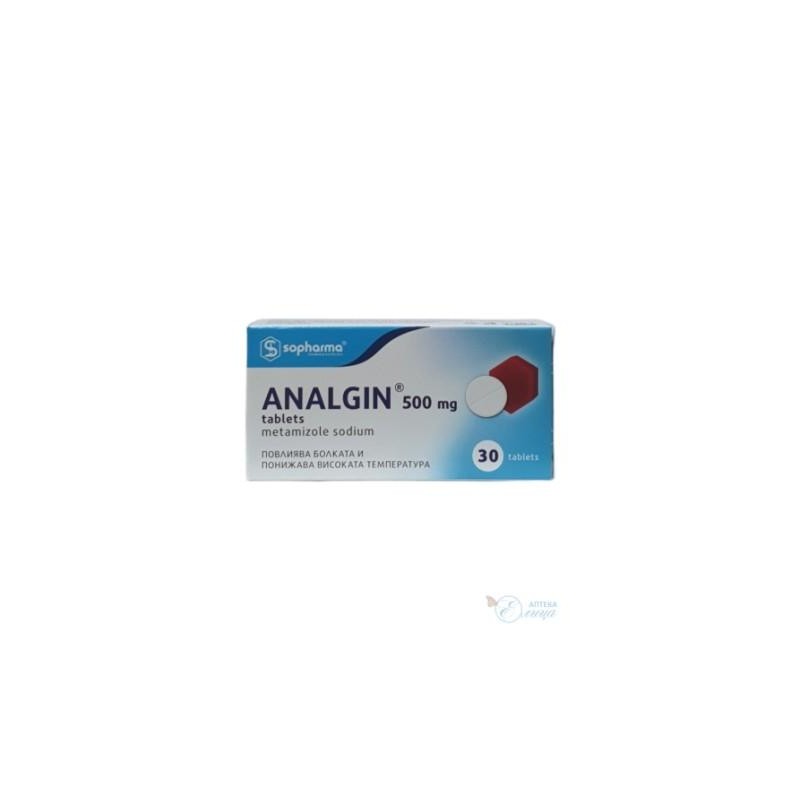
Analgin tablets contain the active substance metamizole sodium, which belongs to the class of pain-relieving medications (analgesics). In addition to relieving pain, it also has a fever-reducing effect.
1. What Analgin is and what it is used for
Analgin tablets contain the active substance metamizole sodium, which belongs to the group of pain-relieving medicines (analgesics). In addition to relieving pain, it also has a fever-reducing effect. Analgin is used for:
the management of moderate to severe pain of various origins: headache, toothache, neuralgia, neuritis, myalgia (muscle pain), injuries, burns, post-operative pain, phantom pain (sensation of pain in the area of a missing limb), menstrual pain, pain associated with oncological diseases, and renal or biliary colic;
reducing high fever.
2. What you need to know before you take Analgin
Do not take Analgin
If you are allergic (hypersensitive) to the active substance metamizole or to any of the other ingredients of this medicine (listed in section 6).
If you have previously experienced a significant decrease in the count of a specific type of white blood cell, known as granulocytes, caused by metamizole or similar medicines called pyrazolones or pyrazolidines.
If you suffer from acute hepatic porphyria (a hereditary disorder affecting red blood cell formation) or congenital glucose-6-phosphate dehydrogenase deficiency (a hereditary disorder involving a deficiency of this enzyme). If you have severe liver and/or kidney disease.
If you have bone marrow problems or a condition that affects how your blood cells are formed or function.
If you are in the last three months of pregnancy.
Warnings and precautions
Talk to your doctor or pharmacist before taking Analgin.
Abnormally low white blood cell count (agranulocytosis)
The use of Analgin can cause agranulocytosis—a condition where the level of a specific type of white blood cell (granulocytes), which are important for fighting infections, becomes very low (see section 4). You must stop taking metamizole and consult a doctor immediately if you experience any of the following symptoms, as they may be signs of potential agranulocytosis: chills, high fever, a sore throat, and painful sores on the mucous membranes—particularly in the mouth, nose, and throat, or in the genital or anal regions. Your doctor will order laboratory tests to check your blood cell counts.
If metamizole is taken to treat a high fever, some symptoms of developing agranulocytosis may go unnoticed. Similarly, if you are undergoing antibiotic treatment, these symptoms may also be masked.
Agranulocytosis can develop at any time during the use of Analgin, and even shortly after you stop taking metamizole. You may develop agranulocytosis, even if you have not experienced any problems with the use of metamizole in the past.
If you are allergic to painkillers or anti-rheumatic drugs, other medications, or foods.
In cases of allergic bronchial asthma (attacks of shortness of breath).
If you have kidney or liver disorders.
If you have low blood pressure.
Liver problems
Inflammation of the liver has been reported in patients taking metamizole, with symptoms developing anywhere from a few days to a few months after starting treatment.
Stop using Analgin and contact a doctor if you experience symptoms of liver problems, such as nausea or vomiting, fever, fatigue, loss of appetite, dark urine, pale stools, yellowing of the skin or the whites of the eyes, itching, a rash, or pain in the upper abdomen. Your doctor will check your liver function.
You must not take Analgin if you have previously taken a medicinal product containing metamizole and experienced liver problems.
Serious skin reactions
Serious skin reactions—including Stevens-Johnson syndrome, toxic epidermal necrolysis, and drug reaction with eosinophilia and systemic symptoms (DRESS)—have been reported in connection with treatment using metamizole. Stop using metamizole and seek medical attention immediately if you notice any of the symptoms associated with these serious skin reactions, as described in section 4.
If you have ever experienced severe skin reactions, you must never resume treatment with Analgin (see section 4).
Other medicines and Analgin
Please inform your doctor or pharmacist if you are taking or have recently taken any other medicines, including those obtained without a prescription.
Concomitant use of metamizole and chlorpromazine (a medicine used to treat mental disorders) may lead to a sharp drop in body temperature.
Concomitant use of metamizole and coumarin anticoagulants, such as acenocoumarol and warfarin (medicines that reduce blood clotting), should be avoided.
Metamizole reduces the effect of cyclosporine (a medicine used following organ transplantation and for the treatment of tumor diseases).
Chloramphenicol and other myelotoxic agents (medicines that impair blood cell formation) increase the risk of adverse effects on the hematopoietic (blood-forming) system when...
...are administered together with metamizole.
Do not take Analgin concurrently with sleeping pills, antidepressants, contraceptives, analgesics, or allopurinol (used to treat gout).
Metamizole may interact with captopril (used to treat heart conditions and high blood pressure), lithium (used to treat mental health conditions), and methotrexate (used to treat rheumatic and oncological diseases). It may also alter the effect of antihypertensive agents (drugs that lower blood pressure) and diuretics (water pills).
When taken together, metamizole (a substance that reduces pain and fever) may diminish the effect of acetylsalicylic acid on platelet aggregation (the clumping together of blood cells to form a blood clot). Consequently, this combination should be used with caution in patients taking low-dose aspirin for cardioprotection.
Metamizole should be used with caution when taken alongside the following medications, as it may reduce their effectiveness:
bupropion, a drug used to treat depression or as an aid for smoking cessation;
efavirenz, a drug used to treat HIV/AIDS;
methadone, a drug used to treat dependence on illicit substances (specifically opioids);
valproate, a drug used to treat epilepsy or bipolar disorder. tacrolimus, a medicine used to prevent organ rejection in transplant patients;
sertraline, a medicine used to treat depression.
Taking Analgin with food and drink
Consumption of alcohol is not recommended during treatment with Analgin, as it may intensify the medicine's adverse effects.
Pregnancy and breastfeeding
If you are pregnant or breastfeeding, think you may be pregnant, or are planning to have a baby, consult your doctor or pharmacist before using this medicine.
Pregnancy
Available data on the use of metamizole during the first three months of pregnancy are limited but do not indicate harmful effects on the embryo. In certain cases, where no other treatment options exist, the administration of single doses of metamizole during the first and second trimesters may be considered—following consultation with a doctor or pharmacist and a careful assessment of the benefits and risks. In general, however, the use of metamizole during the first and second trimesters is not recommended.
You must not take Analgin during the last three months of pregnancy due to an increased risk of complications for both mother and child (such as bleeding or the premature closure of an important blood vessel in the unborn baby—the *ductus arteriosus*—which normally closes only after birth).
Breastfeeding
Metamizole breakdown products pass into breast milk in significant amounts, and a risk to the nursing infant cannot be ruled out. Therefore, repeated use of metamizole during breastfeeding should be avoided. In the event of a single administration of metamizole, mothers are advised to collect and discard breast milk for 48 hours following the dose.
Driving and using machines
When taking high doses of Analgin, it is not recommended to drive motor vehicles or operate machinery requiring active attention, as it may adversely affect alertness and impair reactions in unexpected situations.
Analgin contains wheat starch
The wheat starch in this medicine contains only very small amounts of gluten and is unlikely to cause problems if you have celiac disease (gluten intolerance).
One tablet contains no more than 3.4 micrograms of gluten.
If you have a wheat allergy (a condition different from celiac disease), you should not take this medicine.
Analgin contains sodium
This medicinal product contains 32.7 mg of sodium per tablet, equivalent to 1.6% of the WHO-recommended maximum daily intake of 2 g of sodium for an adult.
3. How to take Analgin
Always take Analgin exactly as described in this leaflet. If you are unsure about anything, ask your doctor or pharmacist.
The dose depends on the intensity of the pain or fever and on individual sensitivity to Analgin. The lowest dose necessary to control pain and fever should be chosen. Your doctor will tell you how to take Analgin.
The tablets are taken by mouth.
Adults and adolescents over 15 years of age
Adults and adolescents aged 15 years or older (weighing more than 53 kg) may take up to 1,000 mg of metamizole as a single dose (2 tablets), which can be taken up to 4 times daily at intervals of 6–8 hours. The maximum daily dose is 4,000 mg (corresponding to 8 tablets).
Children aged 10 to 14 years (weighing from 32 kg to 53 kg)
The following table shows the recommended single doses and maximum daily doses based on weight or age:
Body weight
Single dose
Maximum daily dose
kg Age
tablets mg tablets mg
32–53 10–14 years ½–1 250–500 4 2,000
Children under 10 years of age
Analgin 500 mg tablets are not recommended for children under 10 years of age, as it is not possible to achieve the appropriate dosage for this age group. Other pharmaceutical forms or dosage strengths are available that allow for appropriate dosing in younger children.
A distinct effect can be expected 30 to 60 minutes after oral administration.
Elderly patients and patients with a poor general state of health or renal impairment
The dose should be reduced in elderly patients, debilitated patients, and patients with impaired renal function, as the elimination of metamizole breakdown products may be delayed.
Patients with impaired renal or hepatic function
Since the rate of elimination is reduced in patients with impaired renal or hepatic function, the use of multiple high doses should be avoided. Dose reduction is not required for short-term use only. There is no experience available regarding long-term use.
Duration of treatment
Do not use Analgin for more than 3 to 5 days. If symptoms do not improve or body temperature does not normalize within 3 days, consult your physician. If you have taken more than the required dose of Analgin
Symptoms may include nausea, dizziness, abdominal pain, weakness (potentially leading to loss of consciousness), a sharp drop in blood pressure, and disturbances in heart rhythm.
Seek medical attention immediately if you experience signs such as cold sweats, dizziness, nausea, skin discoloration, or shortness of breath.
If you have missed a dose of Analgin
Do not take a double dose to make up for the missed one.
4. Possible side effects
Like all medicines, Analgin can cause side effects, although not everybody gets them.
Stop using Analgin and contact a doctor immediately if you experience any of the following symptoms:
Nausea or vomiting, fever, fatigue, loss of appetite, dark urine, pale stools, yellowing of the skin or the whites of the eyes, itching, rash, or pain in the upper abdomen. These symptoms may be signs of liver damage. See also section 2, "Warnings and precautions."
Serious skin reactions
Stop using metamizole and seek medical attention immediately if you notice any of the following serious side effects:
Reddish, flat, target-like or circular spots on the trunk—often with central blisters—peeling skin, or ulcers in the mouth, throat, nose, genital area, or eyes. These serious skin rashes may be preceded by fever and flu-like symptoms (Stevens-Johnson syndrome, toxic epidermal necrolysis).
Widespread rash, high body temperature, and enlarged lymph nodes (DRESS syndrome or drug hypersensitivity syndrome). Adverse reactions are classified by frequency as follows: very common (> 1/10), common (> 1/100 to < 1/10), uncommon (> 1/1,000 to < 1/100), rare (> 1/10,000 to < 1/1,000), very rare (< 1/10,000), and not known (cannot be estimated from the available data).
Uncommon (occurring in fewer than 1 in 100 users)
Skin rashes, a drop in blood pressure, and heart rhythm disturbances (rapid or irregular heartbeat).
Rare (occurring in fewer than 1 in 1,000 users)
Leukopenia (a decrease in the number of white blood cells, which increases the likelihood of developing an infection); maculopapular rash (formation of skin plaques and nodules); hypersensitivity reactions (anaphylactic or anaphylactoid reactions) – itching, burning, skin redness, hives (urticaria), swelling (generalized or localized), difficulty breathing, and, rarely, gastrointestinal complaints; angioedema (including laryngeal edema); heart rhythm disturbances; a drop in blood pressure; and kidney impairment, such as the presence of protein in the urine, decreased or increased urine output, or inflammation of the kidneys. Very rare (occurring in fewer than 1 in 10,000 users)
Agranulocytosis (a severe reduction in the number of white blood cells, which increases the likelihood of developing infections); thrombocytopenia (a reduction in the number of platelets, which increases the risk of bleeding or bruising); hemolytic anemia (a reduction in the number of red blood cells, which may lead to paleness or yellowing of the skin, weakness, or shortness of breath); aplastic anemia (a severe reduction in the number of blood cells, leading to weakness, bruising, or an increased likelihood of developing infections); asthmatic attack (in patients with analgesic-induced asthma); circulatory shock.
Frequency unknown: nausea, vomiting, abdominal pain and discomfort; in rare cases, ulceration or bleeding of the gastrointestinal tract lining; inflammation of the liver, yellowing of the skin and the whites of the eyes, elevated liver enzyme levels in the blood; serious skin reactions.
If any of the adverse drug reactions become serious, or if you notice any adverse reactions not listed in this leaflet, please inform your doctor or pharmacist.
5. How to store Analgin
Store in the original packaging to protect from light, at a temperature below 25°C. Keep out of the reach of children. Do not use the product after the expiry date stated on the packaging. The expiry date refers to the last day of the month indicated.
Medicines should not be disposed of via wastewater or household waste. Ask your pharmacist how to dispose of medicines no longer required. These measures will help to protect the environment.
6. Contents of the pack and other information
What Analgin contains
The active substance is metamizole sodium, 500 mg per tablet.
The other ingredients are: microcrystalline cellulose (type 101), magnesium stearate, povidone, wheat starch, and talc.
What Analgin looks like and contents of the pack
Round, flat tablets with a score line on one side, 13 mm in diameter, white to off-white, and odorless. The score line is intended for dividing the tablet into two equal...
...into halves.
10 tablets in a PVC/aluminium foil blister; 1, 2, 3, 6, or 50 blisters in a cardboard box, together with a package leaflet.
Not all pack sizes may be marketed.
Analgin tablets contain the active substance metamizole sodium, which belongs to the class of pain-relieving medications (analgesics). In addition to relieving pain, it also has a fever-reducing effect.