
- New
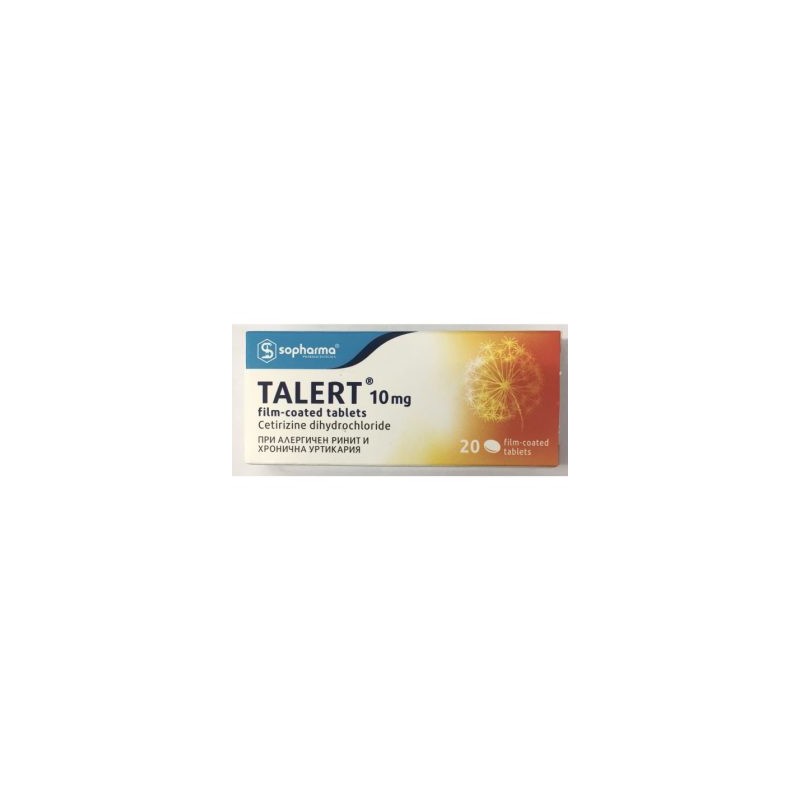
Talert is an anti-allergy medication that contains the active substance cetirizine dihydrochloride.
Talert is used in adults and children over 6 years of age:
1. What Talert is and what it is used for
Talert is an anti-allergy medication containing the active substance cetirizine dihydrochloride.
Talert is used in adults and children over 6 years of age:
to relieve nasal and ocular symptoms of seasonal and perennial allergic rhinitis;
to relieve symptoms of chronic hives (chronic idiopathic urticaria).
If you do not feel better after 3 days, or if your condition worsens, you should seek medical advice.
2. What you need to know before you take Talert
Do not take Talert
if you are allergic (hypersensitive) to cetirizine dihydrochloride or any of the other ingredients of this medicine (listed in section 6), to hydroxyzine, or to other piperazine derivatives (substances similar to the active ingredient in this medicine);
if you have severe kidney impairment (severe renal failure with a creatinine clearance of less than 10 ml/min).
Warnings and precautions
Talk to your doctor or pharmacist before taking Talert.
If you have kidney failure, consult your doctor; if necessary, they will prescribe a lower dose.
If you have difficulty urinating (due to problems with your spinal cord, prostate, or bladder), consult your doctor. If you have epilepsy and are at risk of seizures, you should consult your doctor before using this medicine.
At usual doses, no clinically significant interactions between cetirizine and alcohol (at a blood alcohol concentration of 0.5 g/l, corresponding to a glass of wine) have been observed. There is no data available regarding the safety of taking higher doses of cetirizine together with alcohol. Therefore, as with all antihistamines, concurrent use with alcohol is not recommended.
If you have an allergy test scheduled, ask your doctor whether you need to stop taking Talert for a few days before the test. This medicine may affect your allergy test results.
Other medicines and Talert
Tell your doctor or pharmacist if you are taking, have recently taken, or might take any other medicines, including those obtained without a prescription.
No interactions with other medicines are expected when using cetirizine.
Talert with food and drink
Food does not significantly affect the absorption of cetirizine.
Pregnancy and breastfeeding
If you are pregnant or breastfeeding, think you may be pregnant, or are planning to have a baby, consult your doctor or pharmacist before using this medicine.
Pregnancy
The use of Talert is not recommended during pregnancy. Accidental use by pregnant women is unlikely to cause harm to the fetus; however, the medication should only be used when necessary and following consultation with a doctor.
Breastfeeding
Cetirizine passes into breast milk. Do not take Talert while breastfeeding unless prescribed by a doctor.
Driving and using machines
Clinical studies have shown no impairment of attention, alertness, or the ability to drive following the use of Talert at recommended doses.
If you intend to drive, engage in potentially hazardous activities, or operate machinery, you should carefully assess how the medication affects you after taking Talert. Do not exceed the recommended dose.
Talert contains lactose and wheat starch
This medicinal product contains lactose monohydrate as an excipient. If you have been told by your doctor that you have an intolerance to certain sugars, contact your doctor before taking this medicine.
The product contains wheat starch. It poses no risk to individuals with celiac disease. Patients with a wheat allergy (other than celiac disease) should not take this medication.
3. How to take Talert
Always take Talert exactly as described in this leaflet, or as instructed by your doctor or pharmacist. If you are unsure about anything, consult your doctor or pharmacist.
The tablets should be taken with a glass of liquid. The tablet can be divided into two equal doses.
Adults and children over 12 years of age: 10 mg once daily (1 tablet).
Children aged 6 to 12 years: 5 mg twice daily (1/2 tablet twice daily).
Patients with renal impairment: For patients with moderate renal impairment, a dose of 5 mg once daily is recommended.
If you suffer from severe kidney disease, please contact your doctor, who may adjust the dose accordingly.
If your child suffers from kidney disease, please contact your doctor, who may adjust the dose according to your child's needs.
If you feel that the effect of Talert is too weak or too strong, please consult your doctor.
Duration of treatment
The duration of treatment depends on the type, duration, and response of the symptoms, and is determined by your doctor.
If you have taken more than the required dose of Talert
If you believe you have taken an overdose of Talert, please inform your doctor. They will decide what measures, if any, need to be taken.
Following an overdose
Undesirable effects not described below may occur with increased frequency. The following undesirable effects have been observed: confusion, diarrhea, dizziness, fatigue, headache, malaise, dilation of the pupils, itching, restlessness, unnatural calmness, drowsiness, stupor (numbness/unresponsiveness), an abnormally rapid heart rate, trembling, and urinary retention.
If you forget to take Talert
Do not take a double dose to make up for a missed dose.
If you have any further questions regarding the use of this medicine, ask your doctor or pharmacist.
4. Possible side effects
Like all medicines, Talert can cause side effects, although not everyone gets them.
The following side effects are rare or very rare; however, you should stop taking the medicine and inform your doctor as soon as you notice them:
Allergic reactions, including serious reactions and angioedema (a serious allergic reaction that causes swelling of the face or throat).
These reactions may occur immediately after taking the medicine for the first time, or they may appear later. Common side effects (may affect up to 1 in 10 patients)
Drowsiness
Dizziness, headache
Pharyngitis, rhinitis
Diarrhoea, nausea, dry mouth
Fatigue
Uncommon side effects (may affect up to 1 in 100 patients)
Anxiety
Paraesthesia (unusual sensations on the skin)
Abdominal pain
Itching, rash
Asthenia (exhaustion), malaise
Rare side effects (may affect up to 1 in 1,000 patients)
Allergic reactions, some of which are serious (very rare)
Depression, hallucinations, aggression, confusion, insomnia
Convulsions
Tachycardia (rapid heart rate)
Impaired liver function
Urticaria (hives)
Oedema (swelling)
Weight gain
Very rare side effects (may affect up to 1 in 10,000 patients)
Thrombocytopenia (low platelet count in the blood)
Tics (involuntary and unconscious muscle contractions, mainly in the face)
Syncope (fainting), dyskinesia (involuntary movements), dystonia (abnormal muscle tone), tremors, dysgeusia (altered sense of taste)
Blurred vision, accommodation disorders, oculogyration (uncontrolled circular eye movements)
Angioedema (a serious allergic reaction that causing swelling of the face or throat), fixed drug eruption
Abnormal urinary function (bedwetting, pain and/or difficulty urinating)
Adverse reactions with unknown frequency (frequency cannot be estimated from the available data)
Increased appetite
Recurrent thoughts or ideas about suicide
Amnesia, memory impairment
Vertigo
Urinary retention (inability of the bladder to empty completely)
Inform your doctor if any of the listed adverse reactions occur. At the first signs of a hypersensitivity reaction, stop taking Talert. Your doctor will assess the severity of the condition and decide what further measures need to be taken.
5. How to store Talert
Store in the original packaging, in a dry place protected from light, at a temperature below 30°C.
Keep out of the reach of children.
Do not use Talert after the expiry date stated on the packaging. The expiry date refers to the last day of the month indicated.
Do not dispose of medicines via wastewater or household waste. Ask your pharmacist how to dispose of medicines no longer in use. These measures will help to protect the environment.
6. Contents of the pack and other information
What Talert contains
The active substance is: cetirizine dihydrochloride 10 mg per tablet.
The other ingredients are: lactose monohydrate, wheat starch, magnesium stearate, povidone, Opadry (polyvinyl alcohol; titanium dioxide E171; macrogol; talc).
What Talert looks like and contents of the pack
White to almost white, round, biconvex film-coated tablets, with a score line on one side and a diameter of 7 mm.
The tablet can be divided into two equal doses.
10 film-coated tablets (10 mg each) in a PVC/aluminium foil blister; 1 or 2 blisters in a cardboard box, together with a package leaflet.
Talert is an anti-allergy medication that contains the active substance cetirizine dihydrochloride.
Talert is used in adults and children over 6 years of age: