
- New
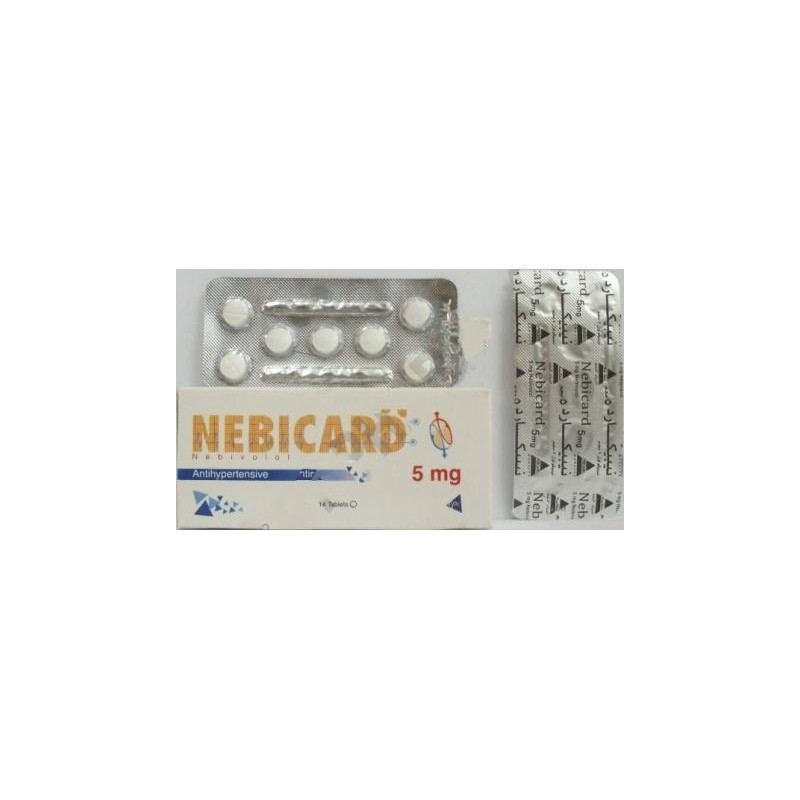
Nebicard contains nebivolol, which is a selective beta-blocker that dilates blood vessels (vasodilator). It is used to treat high blood pressure (hypertension).
1. What Nebicard is and what it is used for
Nebicard contains nebivolol, which is a selective beta-blocker that dilates blood vessels (vasodilator). It is used to treat high blood pressure (hypertension).
Nebicard is also used to treat chronic heart failure in patients aged 70 years or older.
2. What you need to know before you take Nebicard
Do not take Nebicard:
If you are allergic (hypersensitive) to nebivolol or any of the other ingredients of this medicine (listed in section 6).
If you have low blood pressure (systolic or "top" reading is lower than 90 mmHg).
If you suffer from severe circulatory disorders in your arms or legs.
If you have a very slow heart rate (less than 60 beats per minute before starting treatment with this medication).
If you have been diagnosed with heart conduction disorders (such as sick sinus syndrome or atrioventricular block) and do not have a functioning pacemaker.
If you have acute heart failure or are receiving intravenous medication to support your heart function.
If you experience difficulty breathing or wheezing (currently or in the past).
If you have a tumor of the adrenal gland called a pheochromocytoma. If you have severe liver disease or impaired liver function.
If you have metabolic acidosis (such as in patients with diabetes, when blood sugar levels have risen excessively and the blood has become too acidic).
If you are using medicines containing floctafenine or sultopride.
Warnings and precautions
Talk to your doctor or pharmacist before taking Nebicard.
If you suffer from or develop any of the following conditions:
Heart failure (the heart's inability to pump a sufficient amount of blood to meet the body's needs).
Mild (first-degree) atrioventricular block (a type of mild disturbance in cardiac conduction that affects the heart rhythm).
Chest pain caused by the constriction of the coronary arteries (known as Prinzmetal’s angina or variant angina).
Impaired blood supply to the arms or legs—for example, Raynaud’s disease or syndrome, or cramps and pain when walking.
Long-term breathing problems. If you are diabetic, be aware that nebivolol can mask the symptoms of low blood sugar (hypoglycaemia) and may increase the risk of severe hypoglycaemia when used in combination with a specific class of antidiabetic drugs known as sulphonylureas (e.g., gliquidone, gliclazide, glibenclamide, glipizide, glimepiride, or tolbutamide). If you have an overactive thyroid gland, note that Nebicard may mask the symptoms of an excessively high heart rate caused by this condition.
If you have allergies, be aware that allergic reactions may become more severe. If you suffer from the skin condition known as psoriasis, note that Nebicard may exacerbate its symptoms.
If you wear contact lenses, be aware that Nebicard may reduce tear production and cause your eyes to become drier.
In such cases, your doctor may need to adjust your treatment or monitor you more frequently.
Children and adolescents
No studies have been conducted in children and adolescents. For this reason, its use in children and adolescents is not recommended.
If you are scheduled for surgery and require an anaesthetic, it is important to inform the surgeon or dentist that you are taking this medication.
If you have severe kidney disease, do not take this medication for the treatment of heart failure, and inform your doctor. Other medicines and Nebicard
Please inform your doctor or pharmacist if you are taking or have recently taken any other medicines, including those obtained without a prescription.
Always inform your doctor or pharmacist if you are taking any of the following medicines in addition to Nebicard:
Diltiazem or verapamil (used for high blood pressure or other heart problems). Verapamil should not be administered intravenously during treatment with Nebicard.
Other medicines for high blood pressure or other heart problems, known as calcium antagonists, such as amlodipine, felodipine, lacidipine, nifedipine, nicardipine, nimodipine, or nitrendipine.
Other antihypertensive medicines or nitrates for the treatment of chest pain.
Clonidine, guanfacine, methyldopa, moxonidine, or rilmenidine, used for the treatment of high blood pressure.
Medicines for the treatment of arrhythmia (irregular heartbeat), such as quinidine, hydroquinidine, amiodarone, cibenzoline, flecainide, disopyramide, lidocaine, mexiletine, or propafenone.
Tricyclic antidepressants (for the treatment of depression), phenothiazines (for the treatment of psychoses), or barbiturates (for the treatment of epilepsy).
Medicines for diabetes, such as insulin or oral antidiabetic drugs. Digoxin or other so-called digitalis glycosides (for the treatment of heart failure).
Anti-inflammatory analgesics (NSAIDs) for the treatment of pain and inflammation – small daily antithrombotic doses of acetylsalicylic acid (e.g., 50 or 100 mg) can be safely administered...
...together with Nebicard.
Medicines for the treatment of asthma, nasal congestion, or specific eye conditions such as glaucoma (increased intraocular pressure) or pupil dilation.
Anesthetics – always inform the anesthesiologist that you are being treated with Nebicard before undergoing anesthesia.
Cimetidine (for the treatment of excess stomach acid) – you should take Nebicard during a meal, and the antacid product between meals.
Medicines that affect the metabolism of nebivolol, such as terbinafine (for fungal and yeast infections), bupropion (for smoking cessation), chloroquine (for malaria or rheumatoid arthritis), levomepromazine (for psychoses), paroxetine, fluoxetine, and thioridazine (for depression).
Amifostine (a protective agent used during radiotherapy and chemotherapy).
Baclofen (a muscle relaxant).
Mefloquine (an antimalarial agent).
Nebicard with food and drink
Nebicard 5 mg tablets can be taken during or between meals. The tablet (or parts thereof) should be taken with water or another liquid.
Pregnancy, breastfeeding, and fertility
Pregnancy
Nebicard should not be used during pregnancy unless clearly necessary.
Breastfeeding
Breastfeeding is not recommended while taking Nebicard. Consult your doctor or pharmacist before using this medicine.
Driving and using machines
No studies have been conducted on the ability to drive or use machines. When driving or operating machinery, keep in mind that dizziness and fatigue may occur. These effects are more likely to appear at the start of treatment or following a dose increase (see section 4).
Nebicard contains lactose
If you have been told by your doctor that you have an intolerance to some sugars, consult your doctor before taking Nebicard.
3. How to take Nebicard
Always take this medicine exactly as your doctor or pharmacist has told you. If you are not sure about anything, ask your doctor or pharmacist.
Treatment of high blood pressure
The recommended dose is 5 mg (1 tablet) daily. It is best to take the dose at the same time each day.
Elderly patients and patients with kidney problems usually begin treatment with 2.5 mg (1/2 tablet) daily.
The therapeutic effect on blood pressure is noticeable after 1–2 weeks of treatment. In some cases, the optimal effect is observed only after 4 weeks.
Treatment of chronic heart failure
Your treatment must be initiated and monitored by an experienced physician.
Your doctor will start your treatment with 1.25 mg (1/4 tablet) daily. The dose may be increased after 1–2 weeks to 2.5 mg (1/2 tablet) daily, then to 5 mg (1 tablet) daily, and subsequently to 10 mg (2 tablets) daily, until the optimal dose for you is reached.
The maximum recommended dose is 10 mg (2 tablets) daily.
You must remain under the supervision of an experienced physician for 2 hours when starting treatment and with each dose increase.
Your physician may decide to lower your daily dose. You must not stop taking the medication abruptly, as this could lead to a worsening of your heart failure.
Patients with severe kidney disease must not take this medication.
Take the medication once daily, preferably at the same time each day. Your physician may decide to combine your treatment with another medicinal product. Nebicard is not recommended for use in children and adolescents.
If you have taken more Nebicard than you should
If you accidentally take too many tablets (an overdose), you may experience a slow heart rate, low blood pressure, or other heart-related issues, as well as difficulty breathing or wheezing. Contact the nearest hospital, or notify your physician or pharmacist immediately. Please bring the packaging containing the remaining tablets with you. If you miss a dose of Nebicard
If you forget to take your medicine but remember shortly afterwards, take the next tablet at the scheduled time. However, if a longer delay has occurred (e.g., a whole day), skip that dose and take the next tablet the following day at the scheduled time. Do not take a double or larger dose to make up for a missed dose (or doses). You should avoid missing doses frequently.
If you stop taking Nebicard
Consult your doctor before you stop taking Nebicard. Stopping treatment suddenly may cause a severe worsening of your condition's symptoms. This applies particularly to patients with chest pain.
If you have any further questions regarding the use of this medicine, please ask your doctor or pharmacist.
4. Possible side effects
Like all medicines, this medicine can cause side effects, although not everybody gets them.
When Nebicard is used to treat high blood pressure, possible side effects include:
Common side effects (more than 1 in every 100 treated patients, but less than 1 in
every 10 treated):
Headache
Dizziness
Fatigue
Unusual itching or tingling sensation
Diarrhoea
Constipation
Nausea
Shortness of breath
Swelling of the limbs
Uncommon side effects (more than 1 patient in every 1,000 treated, but less than 1 patient in every 100 treated):
Slow heart rate or other heart-related complaints
Low blood pressure
Leg pain while walking, resembling cramps
Visual disturbances
Impotence (difficulty achieving an erection)
Depression
Digestive system problems (dyspepsia), gas (flatulence), vomiting
Rash, itching
Shortness of breath similar to asthma, caused by sudden contraction of the airway muscles (bronchospasm)
Nightmares.
Very rare side effects (less than 1 patient in every 10,000 treated):
Fainting/Syncope
Worsening of existing psoriasis (a skin condition characterized by scaly, pink patches). The following adverse drug reactions during treatment with Nebicard have been reported in only a few isolated cases:
Allergic reactions affecting the entire body, with a generalized skin rash (hypersensitivity reactions),
Rapidly developing swelling, particularly around the lips, eyes, or tongue, which may be accompanied by sudden difficulty breathing (angioedema).
In a clinical trial for chronic heart failure, the following adverse drug reactions were observed:
Very common adverse reactions (occurring in more than 1 in 10 treated patients):
slow heart rate
dizziness.
Common adverse reactions (occurring in more than 1 in 100 treated patients, but in fewer than 1 in 10 treated patients):
worsening of heart failure
low blood pressure (for example, feeling faint upon standing up suddenly)
inability to tolerate this medication
a mild type of heart conduction disorder affecting the heart rhythm (1st-degree AV block)
swelling of the lower limbs (for example, swollen ankles).
5. How to store Nebicard
Keep this medicine out of the sight and reach of children.
Do not use this medicine after the expiry date which is stated on the carton and the blister pack after "EXP".
The expiry date refers to the last day of that month.
Do not store above 30°C.
Do not dispose of medicines via wastewater or household waste. Ask your pharmacist how to dispose of medicines no longer required. These measures will help to protect the environment.
6. Contents of the pack and other information
What Nebicard contains
The active substance is nebivolol. Each tablet contains 5.45 mg of nebivolol hydrochloride, equivalent to 5 mg of nebivolol.
The other ingredients are: lactose monohydrate, crospovidone type A, poloxamer 188, povidone K 30, microcrystalline cellulose, magnesium stearate.
What Nebicard looks like and contents of the pack
Nebicard tablets are white, round, biconvex, with two intersecting score lines on one side, and a diameter of approximately 9 mm. Nebicard can be divided into equal quarters. The tablets are available in PVC/PVDC/aluminium blisters containing 7, 10, or 14 tablets.
Cartons containing 7, 10, 14, 20, 28, 30, 50, 56, 60, 90, 100, or 120 tablets.
Not all pack sizes may be marketed.
Nebicard contains nebivolol, which is a selective beta-blocker that dilates blood vessels (vasodilator). It is used to treat high blood pressure (hypertension).