
- New
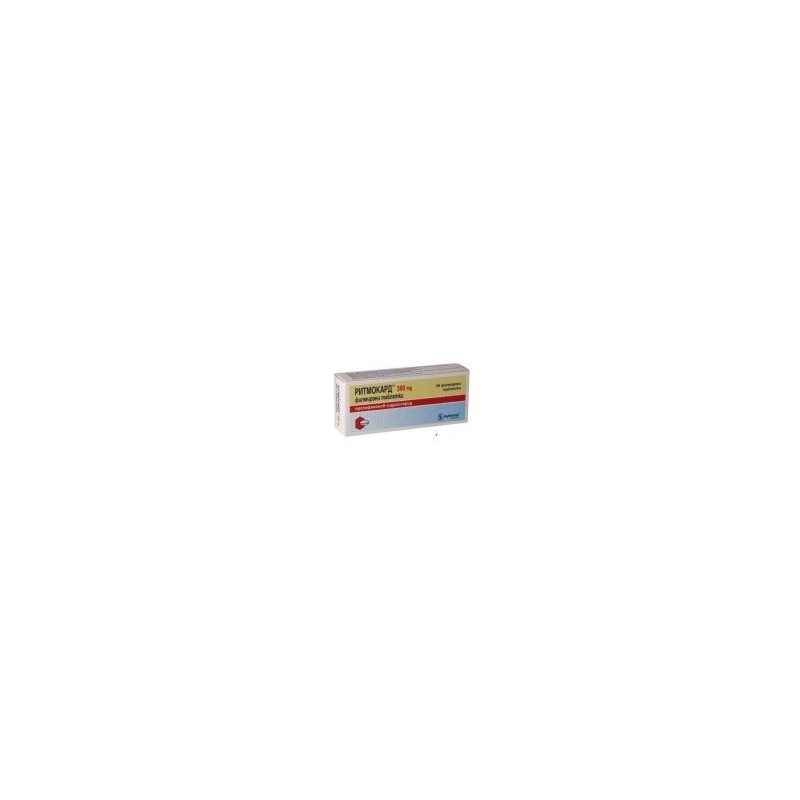
Ritmocard contains the active substance propafenone, which belongs to a group of medicines known as antiarrhythmics. It restores an irregular heart rhythm to normal by affecting cardiac excitability and conduction. It is used for the treatment and prevention of heart rhythm disorders.
1. WHAT RITMOKARD IS AND WHAT IT IS USED FOR
Ritmokard contains the active substance propafenone, which belongs to a group of medicines called antiarrhythmics. It restores an irregular heart rhythm to normal by affecting cardiac excitability and conduction. It is used for the treatment and prevention of heart rhythm disorders.
2. BEFORE YOU TAKE RITMOKARD
Do not take Ritmokard:
if you are allergic (hypersensitive) to the active substance or to any of the other ingredients of Ritmokard;
if you suffer from heart failure or have other heart problems, in addition to an irregular heart rhythm;
if you have a slow heart rate or hypotension (low blood pressure); if you have significant electrolyte imbalances (e.g., in potassium levels); if you have severe obstructive lung disease (e.g., bronchial asthma); or if you have a diagnosed muscle weakness (a condition called myasthenia gravis).
Take special care when using Ritmokard:
Before starting treatment with Ritmokard, inform your doctor:
If you have a pacemaker, its function must be checked and, if necessary, reprogrammed.
Inform your doctor if you suffer from liver, kidney, or lung diseases. If you are about to undergo surgical or dental procedures, inform your doctor that you are being treated with Ritmocard, as it may affect the efficacy and safety of the anesthetics used.
Taking other medicines
Please inform your doctor or pharmacist if you are taking or have recently taken any other medicines, including those obtained without a prescription.
Ritmocard may alter the activity of the following medicines, or conversely, they may alter its effects:
other medicines that affect heart function, such as digoxin or quinidine; medicines that prevent blood clotting (warfarin); certain antibiotics (erythromycin, rifampicin);
medicines that suppress heart rhythm and/or contractility, such as beta-blockers (propranolol, metoprolol) or calcium channel blockers (verapamil, diltiazem); antiviral medicines such as ritonavir;
tricyclic and other antidepressants (amitriptyline, desipramine, venlafaxine); cimetidine (for the treatment of ulcers); cyclosporine (used following organ transplantation and for the treatment of arthritis or psoriasis); theophylline (used in the treatment of asthma); ketoconazole (an antifungal medicine); and phenobarbital (for the treatment of epilepsy). Taking Ritmocard with food and drink
If you are being treated with Ritmocard, you should avoid grapefruit juice. It may increase plasma levels of propafenone.
Pregnancy and breastfeeding
Consult your doctor or pharmacist before using any medicine. Propafenone crosses the placental barrier; therefore, the medicinal product should be used in pregnant women only when the expected benefit to the mother outweighs the potential risk to the fetus. It is excreted in breast milk; consequently, if treatment is necessary for a breastfeeding woman, breastfeeding must be discontinued.
Driving and using machines
Depending on individual tolerance, Ritmocard may cause dizziness, fatigue, or visual disturbances. Ritmocard may slow down reaction times to an extent that impairs the ability to drive, operate machinery, or work under hazardous conditions. This applies particularly at the start of treatment, when the dose is increased, when switching to another medication, or when used concurrently with alcohol.
Important information about some of the ingredients of Ritmocard
The medicinal product contains wheat starch. It poses no risk to individuals with celiac disease. Patients with a wheat allergy (other than celiac disease) should not take this medicine.
3. HOW TO TAKE RITMOCARD
Always take Ritmocard exactly as your doctor has instructed you. If you are unsure about anything, ask your doctor or pharmacist.
Initiating treatment with antiarrhythmic medicinal products requires strict supervision and must be carried out in a hospital setting equipped with emergency therapy facilities and monitoring capabilities.
Determining the individual dosage for each patient must be done under the supervision of a cardiologist, with repeated checks of the ECG and blood pressure—ideally within a healthcare facility.
Follow-up examinations are necessary during the course of treatment.
The tablets are taken orally, after meals; they should be swallowed whole (not chewed) with a sufficient amount of water (do not take with grapefruit juice).
For initial and maintenance treatment, a daily dose of 450 mg is recommended, divided into 3 doses taken at 8-hour intervals. If necessary—and in the absence of a therapeutic effect—the dose may be gradually increased at intervals of 3–4 days, up to a maximum dose of 900 mg, divided into 3 doses taken at 8-hour intervals.
For patients with a lower body weight (under 70 kg), elderly patients, and patients with renal or hepatic (kidney or liver) diseases, the daily doses should be reduced.
The Ritmokard 150 mg and 300 mg film-coated tablet dosage forms are not suitable for accurate dosing in children.
If you have taken more Ritmokard than you should
If you have taken more than the required dose, inform your doctor immediately or contact the nearest emergency department.
If you have missed a dose of Ritmokard
If you miss a dose, take it as soon as possible. If it is almost time for your next dose, take it as usual. Do not take a double dose to make up for a forgotten one, as this may increase the likelihood of adverse reactions. Continue taking the medication as prescribed.
If you stop taking Ritmokard
Do not stop treatment without consulting a doctor!
If you have any further questions regarding the use of this product, please ask your doctor or pharmacist.
4. POSSIBLE ADVERSE REACTIONS
Like all medicines, Ritmokard can cause adverse reactions, although not everyone gets them. The following adverse drug reactions may be observed more frequently: loss of appetite, nausea, dry mouth, a bitter taste, vomiting, abdominal pain, constipation or diarrhea, abdominal bloating, impaired coordination, dizziness, headache, visual disturbances, easy fatigability, a drop in blood pressure, and an exacerbation of heart rhythm disorders. Less frequently, the following may occur: nightmares, sleep disturbances, anxiety, confusion, tremors, and seizures. Allergic reactions, such as skin redness, itching, or a rash, may occur rarely. Allergic reactions can affect the liver. Notify your doctor immediately if you notice a rash or a yellowing of the skin and/or eyes. Allergic reactions resolve upon discontinuation of treatment.
In very rare cases, changes in the blood count may occur. Notify your doctor immediately if you bruise easily following minor injuries or frequently suffer from tonsillitis accompanied by a high fever.
Changes in liver function tests, jaundice, and drug-induced liver injury (which is reversible upon stopping treatment) are also possible.
If any of the adverse drug reactions become serious, or if you notice any side effects not listed in this leaflet, please inform your doctor or pharmacist.
5. STORAGE OF RITMOKARD
Store in the original packaging to protect from light and moisture. Store below 25°C.
Keep out of the reach of children.
Do not use Ritmocard after the expiry date stated on the carton. The expiry date refers to the last day of the month indicated.
Medicines should not be disposed of via wastewater or household waste. Ask your pharmacist how to dispose of medicines no longer required. These measures will help to protect the environment.
6. FURTHER INFORMATION
What Ritmocard contains
The active substance is propafenone hydrochloride, 150 mg or 300 mg.
The other ingredients are:
150 mg film-coated tablet: wheat starch, copovidone, magnesium stearate, microcrystalline cellulose (type 101), sodium starch glycolate (type A), Opadry II Yellow (E172, E171, E464). 300 mg film-coated tablet: wheat starch, copovidone, magnesium stearate, microcrystalline cellulose (type 101), sodium starch glycolate (type A), Opadry II White (E171, E464).
What Ritmocard looks like and contents of the pack
150 mg film-coated tablets: round, biconvex, yellow film-coated tablets with a diameter of 9 mm. 10 film-coated tablets in a PVC/aluminium foil blister; 5 blisters in a cardboard box, together with a package leaflet.
300 mg film-coated tablet: round, biconvex, white, film-coated tablets with a diameter of 11 mm. 10 film-coated tablets in a PVC/aluminium foil blister; 3 blisters in a cardboard box, together with a package leaflet.
Ritmocard contains the active substance propafenone, which belongs to a group of medicines known as antiarrhythmics. It restores an irregular heart rhythm to normal by affecting cardiac excitability and conduction. It is used for the treatment and prevention of heart rhythm disorders.