
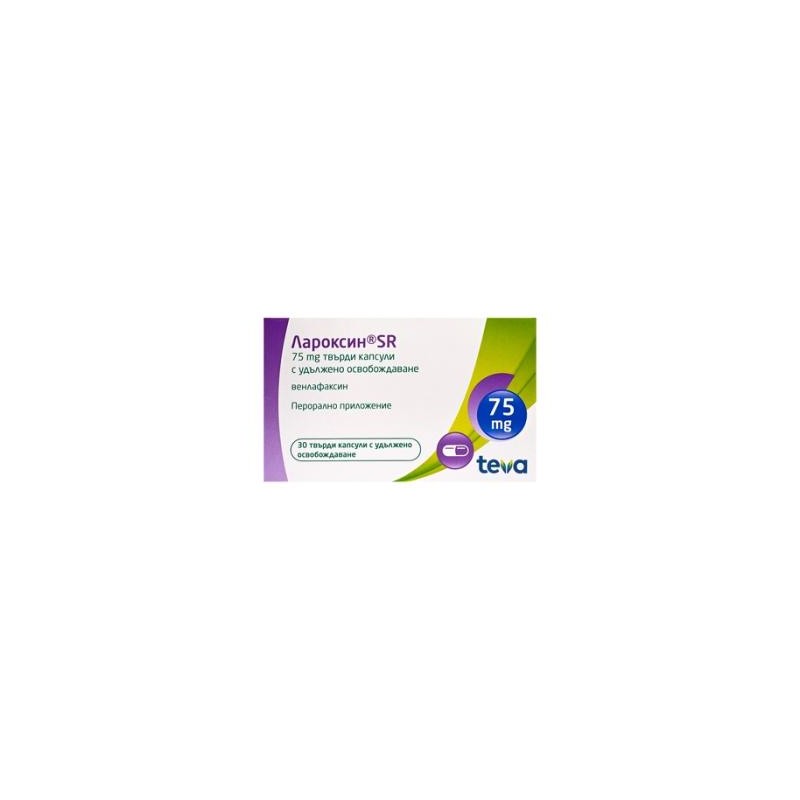
Laroxin XR contains the active substance venlafaxine.
Laroxin XR is an antidepressant that belongs to a group of medicines called serotonin and norepinephrine reuptake inhibitors (SNRIs). This group of medicines is used to treat depression and other conditions such as anxiety disorders,
1. What is Laroxin XR and what is it used for
Laroxin XR contains the active substance venlafaxine.
Laroxin XR is an antidepressant that belongs to a group of medicines called serotonin and norepinephrine reuptake inhibitors (SNRIs). This group of medicines is used to treat depression and other conditions such as anxiety disorders. People who are depressed and/or anxious are thought to have lower levels of serotonin and norepinephrine in the brain. It is not fully understood how antidepressants work, but they may help by increasing the levels of serotonin and norepinephrine in the brain.
Laroxin XR is used to treat adults with depression. It is also used to treat adults with the following anxiety disorders: generalised anxiety disorder, social anxiety disorder (fear and avoidance of social situations) and panic disorder (panic attacks). Getting your depression or anxiety disorders treated properly is important to help you feel better. If left untreated, your condition may not improve and may become more serious and more difficult to treat.
2. What you need to know before you take venlafaxine XR
Do not take venlafaxine XR:
if you are allergic to venlafaxine or any of the other ingredients of this medicine (listed in section 6);
if you are also taking or have taken in the last 14 days any medicines known as irreversible monoamine oxidase inhibitors (MAOIs), which are used to treat depression or Parkinson's disease. Taking an irreversible MAOI with venlafaxine XR can cause serious or even life-threatening side effects. You should also wait at least 7 days after you stop taking venlafaxine XR before taking any MAOIs (see also the section called "Other medicines and venlafaxine XR" and the information in this section on "Serotonin syndrome").
Warnings and precautions
Talk to your doctor or pharmacist before taking Laroxin XR:
if you are using other medicines that, when taken at the same time as Laroxin XR, could increase the risk of developing serotonin syndrome (see section u Other medicines and Laroxin XR");
if you have eye problems, such as certain types of glaucoma (increased pressure inside the eye);
if you have a history of high blood pressure;
if you have a history of heart problems;
if you have been told you have an irregular heartbeat;
if you have a history of fits (convulsions);
if you have a history of low sodium levels in your blood (hyponatraemia); if you have a tendency to bruise or bleed easily (history of blood clotting disorders), or if you are taking other medicines that may increase the risk of bleeding, e.g. warfarin (used to prevent blood clots) or if you are pregnant (see section "Pregnancy and breast-feeding")); if you have a history, or if someone in your family has had, mania or bipolar disorder (feeling overexcited or euphoric); if you have a history of aggressive behavior.
During the first few weeks of treatment, Laroxin XR may cause a feeling of restlessness or an inability to sit or stand still. You should tell your doctor if this happens to you.
Do not drink alcohol while being treated with Laroxin XR, as this can lead to extreme tiredness and loss of consciousness. Concomitant use with alcohol and/or certain medicines can worsen the symptoms of depression and other illnesses, such as anxiety disorders.
Thoughts of suicide and worsening of your depressive or anxiety disorder
If you are depressed and/or have anxiety disorders, you may sometimes have thoughts of harming or killing yourself. These thoughts may be more likely when you first start taking antidepressants, as all these medicines take time to work, usually about two weeks but sometimes longer. These thoughts may also occur when the dose is reduced or when treatment with Laroxin XR is stopped.
You are more likely to think like this:
if you have previously had thoughts of killing or harming yourself;
if you are a young person. Information from clinical trials has shown an increased risk of suicidal behaviour (suicidal thoughts) in young people (under 25 years of age) with mental health conditions who have been treated with an antidepressant.
If you ever have thoughts of harming or killing yourself, contact your doctor or go to a hospital straight away.
It may help to tell a relative or close friend that you are depressed or have an anxiety disorder, and ask them to read this leaflet. You can ask them to tell you if they think your depression or anxiety is getting worse or if they are worried about changes in your behaviour.
Dry mouth
Dry mouth has been reported in 10% of patients treated with venlafaxine. This may increase the risk of tooth decay. Therefore, you should
Pay special attention to your dental hygiene.
Diabetes
The use of Laroxin XR may affect your blood sugar levels, which may require an adjustment of your antidiabetic medicine.
Sexual problems
Medicines such as Laroxin XR (called serotonin and noradrenaline reuptake inhibitors) can cause symptoms of sexual dysfunction (see section 4). In some cases, these symptoms continue after stopping treatment.
Small spheres in your stools
Do not be concerned if you notice small white granules or balls in your stools after taking this medicine. Inside Laroxin XR capsules are microspheres (small white balls) that contain the active substance (venlafaxine). These microspheres are released from the capsule in your gastrointestinal tract. As they pass through your gastrointestinal tract, venlafaxine is slowly released, the “shell” of the microspheres remains undissolved and is passed out in your stools. So even though you may notice microspheres in your stools, your dose of medicine has been absorbed.
Use in children and adolescents
Laroxin XR should not usually be used in children and adolescents under 18 years of age. You should also be aware that in patients under 18 years of age, the risk of side effects such as suicide attempts, suicidal thoughts and hostility (predominantly aggression, oppositional behaviour and anger) is increased when they take this class of medicines. However, your doctor may prescribe this medicine for patients under 18 years of age because he/she decides whether it is in their best interest. If your doctor has prescribed this medicine for a patient under 18 years of age and you want to discuss this, please go back to your doctor. You should inform your doctor if any of the symptoms listed above develop or worsen when patients under 18 years of age are taking Laroxin XR. In addition, the effects related to the safety of this medicine after long-term use on growth, maturation and development of cognitive abilities and behavior in this age group have not yet been demonstrated.
Other medicines and Laroxin XR
You should tell your doctor or pharmacist if you are taking, have recently taken or might take any other medicines.
Your doctor should decide whether you can take Laroxin XR with other medicines.
Do not start or stop taking any medicines, including those bought without a prescription, natural or herbal medicines, before checking with your doctor or pharmacist.
Monoamine oxidase inhibitors, which are used to treat depression or Parkinson's disease, should not be taken with Laroxin XR. Tell your doctor if you have taken such medicines in the last 14 days (MAOIs: see section "What you need to know before you take Laroxin XR")
Serotonin syndrome:
A potentially life-threatening condition or reactions similar to those of neuroleptic malignant syndrome (NMS) (see section "Possible side effects"), may occur with venlafaxine treatment, especially when it is taken with other medicines.
Examples of such medicines are:
triptans (used for migraine);
other medicines to treat depression, such as SNRIs, SSRIs, tricyclic antidepressants or medicines containing lithium;
medicines containing amphetamines (used to treat Attention Deficit Hyperactivity Disorder (ADHD), narcolepsy and obesity);
medicines containing linezolid, which is an antibiotic (used to treat infections);
medicines containing moclobemide, which is an MAOI (used to treat depression);
medicines containing sibutramine (used for weight loss);
medicines containing opioids (e.g. buprenorphine, tramadol, fentanyl, tapentadol, pethidine or pentazocine, which are used to control severe pain;
medicines containing dextromethorphan (used to treat cough);
medicines containing methadone (used to treat opioid dependence or severe pain);
medicines containing methylene blue (used to treat high levels of methaemoglobin in the blood);
products containing St. John's wort (also called Hypericum perforatum, which is a natural or herbal medicine used to treat mild depression);
medicines containing tryptophan (used for problems such as sleep and depression);
antipsychotics (used to treat illnesses with symptoms such as hearing, seeing or sensing things that are not there, mistaken beliefs, unusual suspiciousness, unclear motives and withdrawal)
Signs and symptoms of Serotonin syndrome may be a combination of the following: restlessness, hallucinations, loss of coordination, fast heartbeat, increased body temperature, rapid changes in blood pressure, overactive reflexes, diarrhea, coma, nausea, vomiting.
In its most severe form, serotonin syndrome may resemble neuroleptic malignant syndrome (NMS). Signs and symptoms of NMS may include a combination of fever, fast heartbeat, increased sweating, severe muscle stiffness, confusion, increased muscle enzymes (seen in a blood test).
Tell your doctor immediately or go to the emergency department of your nearest hospital if you think you are having serotonin syndrome.
You should tell your doctor if you are taking any medicines that may affect your heart rhythm.
Examples of such medicines include:
antiarrhythmics, such as quinidine, amiodarone, sotalol or dofetilide (used to treat irregular heartbeats) rhythm);
antipsychotics such as thioridazine (see also “Serotonin syndrome” above);
antibiotics such as erythromycin or moxifloxacin (used to treat bacterial infections);
antihistamines (used to treat allergies).
The following medicines may also interact with Laroxin XR and should be used with caution. It is especially important to tell your doctor or pharmacist if you are taking medicines containing:
ketoconazole (an antifungal medicine);
haloperidol or risperidone (to treat mental conditions);
metoprolol (a beta-blocker to treat high blood pressure and heart problems).
Laroxin XR with food, drink and alcohol
Laroxin XR should be taken with food (see section 3 “How to take Laroxin XR”)
Do not drink alcohol while you are being treated with Laroxin XR. Concomitant use with alcohol may cause extreme tiredness and loss of consciousness and may worsen your symptoms of depression and other diseases, such as anxiety disorders.
Pregnancy and breast-feeding
If you are pregnant or breast-feeding, think you may be pregnant or are planning to have a baby, ask your doctor or pharmacist for advice before using this medicine. You should only use Laroxin XR after discussing with your doctor the possible benefits and the possible risks to your unborn baby.
Make sure your midwife and/or doctor know that you are taking Laroxin XR. When taken during pregnancy, similar medicines (SSRIs) may increase the risk of serious complications in
in newborns, called persistent pulmonary hypertension of the newborn (PPHN), which causes the baby to breathe faster and turn blue. These symptoms usually start within the first 24 hours after the baby is born. If this happens to your baby, contact your midwife and/or doctor immediately.
If you take Laroxin XR towards the end of your pregnancy, there may be an increased risk of heavy vaginal bleeding soon after birth, especially if you have a history of a bleeding disorder. Your doctor or midwife should know that you are taking Laroxin XR so that they can advise you.
If you take this medicine during pregnancy, another symptom that may be seen in your baby when it is born, in addition to the problem with breathing, is that it does not feed well. If your baby has these symptoms when it is born and you are concerned, contact your doctor and/or midwife who will be able to advise you.
Laroxin XR passes into breast milk. There is a risk that it may affect the baby. Therefore, you should discuss this with your doctor and he/she will decide whether you should stop breast-feeding or stop taking this medicine.
Driving and using machines
Do not drive or use any tools or machines until you know how this medicine affects you.
Laroxin XR contains
Sucrose
If your doctor has told you that you have an intolerance to some sugars, contact your doctor before taking this medicine.
3. How to take Laroxin XR
Always take this medicine exactly as your doctor has told you. If you are not sure, ask your doctor or pharmacist.
The usual recommended starting dose for the treatment of depression, generalised anxiety disorder and social anxiety disorder is 75 mg per day. The dose may be increased by your doctor gradually, and if necessary, it may reach a maximum daily dose of 375 mg in the treatment of depression. If you are being treated for panic disorder, your doctor will start you on a lower dose (37.5 mg) and then gradually increase your dose. The maximum dose for generalised anxiety disorder, social anxiety disorder and panic disorder is 225 mg per day.
Laroxin XR is for oral use.
Take Laroxin XR at about the same time each day, either in the morning or in the evening. To ensure that the pellets (the microspheres inside the capsules) are completely swallowed, the capsules should be swallowed whole with liquid and should not be opened, broken, chewed or dissolved.
Laroxin XR should be taken with food.
If you have liver or kidney problems, talk to your doctor as your dose may need to be changed.
Do not stop taking this medicine without first talking to your doctor (see section “If you stop taking Laroxin XR”).
If you take more Laroxin XR than you should
Call your doctor or pharmacist immediately if you take more of this medicine than your doctor has prescribed.
Overdose can be life-threatening, especially if you also take alcohol and/or certain medicines (see “Other medicines and Laroxin XR”).
Symptoms of a possible overdose may include a fast heart rate, changes in level of consciousness (ranging from drowsiness to coma), blurred vision, seizures or fits, and vomiting.
If you miss a dose of Laroxin XR
If you miss a dose, take it as soon as you remember. However, if it is almost time for your next dose, skip the missed dose and take only a single dose as usual. Do not take a double dose to make up for a missed dose. Do not take more Laroxin XR than prescribed for you in a day.
If you stop taking Laroxin XR
Do not stop taking your treatment or reduce your dose without your doctor's advice, even if you feel better. If your doctor thinks you no longer need Laroxin XR, he/she may ask you to slowly reduce your dose before stopping treatment completely. Side effects are known to occur when people stop taking this medicine, especially when it is stopped suddenly or the dose is reduced too quickly. Some patients may experience symptoms such as suicidal thoughts, aggression, tiredness, dizziness, lightheadedness, headache, drowsiness, nightmares, dry mouth, loss of appetite, nausea, diarrhea, nervousness, agitation, confusion, ringing in the ears, tingling or, rarely, electric shock-like sensations, weakness, sweating, seizures or flu-like symptoms, vision problems and an increase in blood pressure (which can cause headache, dizziness, ringing in the ears, sweating, etc.).
Your doctor will advise you on how to gradually stop treatment with Laroxin XR. This may take up to several weeks or months. In some patients, it may be necessary to stop treatment gradually.
It happens more gradually, over months or longer. If you experience any of these or other symptoms that worry you, contact your doctor for further advice.
If you have any further questions on the use of this medicine, ask your doctor or pharmacist.
4. Possible side effects
Like all medicines, this medicine can cause side effects, although not everybody gets them.
If you experience any of the following, stop taking Laroxin XR. Tell your doctor immediately or go to the emergency department at your nearest hospital:
Uncommon (may affect up to 1 in 100 people)
swelling of the face, lips, tongue, throat, hands or feet and/or a raised itchy rash (hives), difficulty swallowing or breathing
Uncommon (may affect up to 1 in 100 people)
hyperactivity, racing thoughts and reduced need for sleep (mania);
hallucinations; feeling detached (or detached) from reality; abnormal orgasm; lack of feelings or emotions; feeling overexcited; grinding your teeth;
fainting; involuntary muscle movements; impaired coordination and balance;
dizziness (especially when you stand up too quickly); low blood pressure;
vomiting blood, black stools (faeces) or blood in the stools; which may be a sign of internal bleeding;
sensitivity to sunlight; bruising; abnormal hair loss
inability to control urination;
stiffness, spasms and involuntary muscle movements;
slight changes in liver enzyme levels in the blood.
Rare (may affect up to 1 in 1,000 people)
seizures or fits;
cough, wheezing and shortness of breath, which may be accompanied by a high temperature;
drinking large amounts of water (known as SNHA);
low levels of sodium in the blood;
severe eye pain and decreased or blurred vision;
severe abdominal or back pain (which may indicate a serious problem with the gut, liver or pancreas);
itching, yellowing of the skin or eyes, dark urine or flu-like symptoms, which are symptoms of liver inflammation (hepatitis);
disorientation and confusion, often accompanied by hallucinations (delirium);
irregular, fast and uneven heartbeat, which may lead to fainting.
Very rare (may affect up to 1 in 10,000 people)
prolonged bleeding, which may be a sign of a reduced number of platelets in your blood, which increases the risk of bruising or bleeding;
abnormal milk production
unexpected bleeding, such as bleeding from the gums, blood in the urine or vomit, or unexpected bruising or broken blood vessels; bulging veins)
Not known (frequency cannot be estimated from the available data)
suicidal thoughts and attempts; thoughts and attempts of suicide have been reported during treatment with venlafaxine or shortly after stopping treatment (see section 2, “What you need to know before you take Laroxin XR”);
aggression;
dizziness;
severe vaginal bleeding soon after giving birth (postpartum haemorrhage), see “Pregnancy and breast-feeding” in section 2 for more information.
Laroxin XR sometimes causes side effects that you may not notice, such as increased blood pressure or irregular heartbeat; slight changes in liver enzymes, sodium or cholesterol in the blood. Less commonly, Laroxin XR can reduce the function of platelets in your blood, which leads to an increased risk of bruising or bleeding. Therefore, your doctor may want to do blood tests from time to time, especially if you have been taking Laroxin XR for a long time.
5. How to store Laroxin XR
Keep out of the reach and sight of children.
Do not use this medicine after the expiry date which is stated on the carton and blister after “EXP”. The expiry date refers to the last day of that month.
Store below 30°C.
Do not throw away any medicines via wastewater or household waste. Ask your pharmacist how to throw away medicines you no longer use. These measures will help protect the environment.
6. Contents of the pack and other information
What Laroxin XR contains:
The active substance is venlafaxine.
Laroxin XR 37.5 mg:
Each prolonged-release capsule contains venlafaxine hydrochloride equivalent to 37.5 mg venlafaxine.
Laroxin XR 75 mg:
Each prolonged-release capsule contains venlafaxine hydrochloride equivalent to 75 mg venlafaxine.
Laroxin XR 150 mg:
Each prolonged-release capsule contains venlafaxine hydrochloride equivalent to 150 mg venlafaxine.
The other ingredients are:
Capsule contents: sugar spheres (containing sucrose and maize starch), hypromellose, ethylcellulose, talc
Capsule shell:
Laroxin XR 37.5 mg:
Black iron oxide (E 172), titanium dioxide (E 171), gelatin, red iron oxide (E 172)
Laroxin XR 75 mg:
Red iron oxide (E 72), titanium dioxide (E 171), gelatin
Laroxin XR 150 mg:
Yellow iron oxide (E 172), titanium dioxide (E 171), gelatin, red iron oxide (E 172)
Printing ink: shellac, propylene glycol (E 1520), concentrated ammonia solution, black iron oxide (E 172), potassium hydroxide
What Laroxin XR looks like and contents of the pack:
Laroxin XR 37.5 mg
Hard gelatin capsules, with opaque grey cap and opaque pink body, filled with white to beige microgranules. The capsules are printed in black ink with "VNE" on the cap and the number "37.5" on the body. The capsule has approximate dimensions of 16 mm x 6 mm.
Laroxin XR 75 mg
Hard gelatin capsules, with opaque pink cap and opaque pink body, filled with white to beige microgranules
. The capsules are printed in black ink with "VNL" on the cap and the number "75" on the body. The capsule has approximate dimensions of 20 mm x 7 mm.
Laroxin XR 150 mg
Hard gelatin capsules, with opaque brown cap and opaque brown body, filled with white to beige microgranules. The capsules are printed in black ink with "VNL" on the cap and the number "150" on the body. The capsule has approximate dimensions of 24 mm x 8 mm.
Blisters of 10, 14, 20, 28, 30, 50, 98, 100 prolonged-release hard capsules or perforated unit dose blisters of 100x1 prolonged-release hard capsules.
Laroxin XR 37.5 mg:
HDPE bottles with PP screw cap: Pack of 150 prolonged-release hard capsules.
Laroxin XR 75 mg: Laroxin XR 150 mg:
HDPE bottles with PP screw cap: Pack of 30, 150 prolonged-release hard capsules.
Not all pack sizes may be marketed.
Laroxin XR contains the active substance venlafaxine.
Laroxin XR is an antidepressant that belongs to a group of medicines called serotonin and norepinephrine reuptake inhibitors (SNRIs). This group of medicines is used to treat depression and other conditions such as anxiety disorders,