

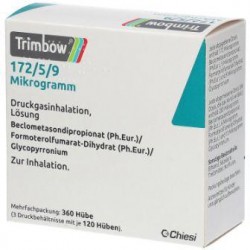
Trimbow is a medicine to improve breathing, which contains the three active substances:
beclomethasone dipropionate,
formoterol fumarate dihydrate and
glycopyrronium.
1. What Trimbow is and what it is used for
Trimbow is a medicine to improve breathing, which contains the three active substances:
beclomethasone dipropionate,
formoterol fumarate dihydrate and
glycopyrronium.
Beclomethasone dipropionate belongs to a group of medicines called corticosteroids, which work to reduce swelling and irritation in your lungs.
Formoterol and glycopyrronium are medicines called long-acting bronchodilators. They work in different ways to relax the muscles in the airways, helping to widen the airways and allowing you to breathe more easily.
Regular treatment with these three active substances helps relieve and prevent symptoms such as shortness of breath, wheezing and cough in adult patients with obstructive pulmonary disease.
Trimbow is used for the regular treatment of asthma in adults.
Trimbow can reduce exacerbations (attacks) of asthma symptoms. Asthma is a serious, long-term disease in which the muscles around the airways contract (bronchoconstriction), swell and become inflamed (inflammation). Symptoms come and go and include shortness of breath, wheezing, chest tightness and coughing.
You should use Trimbow every day, not just when you have trouble breathing or other asthma symptoms. This will ensure that the medicine controls your asthma properly. Do not use this medicine to relieve a sudden attack of shortness of breath or wheezing.
2. What you need to know before you use Trimbow
Do not use Trimbow
If you are allergic to beclomethasone dipropionate, formoterol fumarate dihydrate and/or glycopyrronium, or to any of the other ingredients of this medicine (listed in section 6).
Warnings and precautions
Trimbow is used as a maintenance treatment for obstructive pulmonary disease. Do not use this medicine to treat a sudden attack of shortness of breath or wheezing.
If your breathing gets worse
If you develop worsening shortness of breath or wheezing (wheezing) immediately after inhaling your medicine, stop using your Trimbow inhaler and immediately use your inhaler with a fast-acting 'reliever' medicine. You should contact your doctor immediately. Your doctor will assess your symptoms and, if necessary, you may start another treatment.
See also section 4 "Possible side effects".
If your lung disease gets worse
If your symptoms get worse or are difficult to control (eg if you use a separate inhaler with a 'reliever' medicine more often) or if the 'reliever' medicine does not improve your symptoms, see your doctor straight away. Your lung disease may be getting worse and your doctor may need to prescribe another treatment.
Talk to your doctor or pharmacist before using Trimbow:
if you have any heart problems, for example angina (heart pain, chest pain), recent heart attack (myocardial infarction), heart failure, narrowing of the arteries around the heart (coronary heart disease), heart valve disease or any other abnormalities related to the heart, or if you have a condition known as hypertrophic obstructive cardiomyopathy (also known as COPD - a disease in which the heart muscle is damaged);
if you have heart rhythm disorders such as an irregular heartbeat, fast heart rate or palpitations, or if you have been told that your electrocardiogram (ECG) is abnormal;
if you have narrowing of the arteries (known as arteriosclerosis), if you have high blood pressure or if you have an aneurysm (a diseased swelling of the wall of a blood vessel);
if you have an overactive thyroid gland;
if you have low levels of potassium in your blood (hypokalaemia). Combining Trimbow with certain other medicines for lung disease or medicines such as diuretics (medicines to drain the body to treat heart disease or high blood pressure) may cause the level of potassium in the blood to drop sharply. For this reason, your doctor may want to measure the potassium levels in your blood from time to time;
if you have any liver or kidney disease;
if you have diabetes. High doses of formoterol can raise your blood sugar, so you may need to have extra blood tests to check your blood sugar when you start using this medicine and occasionally during treatment;
if you have a tumor of the adrenal glands (known as pheochromocytoma);
if you will be anaesthetized. Depending on the type of anaesthetic, you may need to stop using Trimbow for at least 12 hours beforehand;
if you are being treated or have ever been treated for tuberculosis (TB), or if you have a chest infection;
if you have an eye problem called narrow-angle glaucoma;
if you have difficulty urinating;
if you have a mouth or throat infection.
If any of the above apply to you, tell your doctor before using Trimbow.
If you have
or have had any medical problems or allergies, or if you are not sure if you can use Trimbow, talk to your doctor or pharmacist before using the inhaler.
If you are already using Trimbow
If you use Trimbow or high doses of other inhaled corticosteroids for long periods of time and find yourself in a stressful situation (eg if you are admitted to hospital after an accident, have a serious injury or before surgery), you may need this medicine more. In such a situation, your doctor may need to increase the dose of corticosteroids to cope with the stress, and may prescribe them in the form of tablets or injections.
Contact your doctor if you have blurred vision or other visual disturbances.
Children and adolescents
Do not give this medicine to children and adolescents under 18 years of age.
Other medicines and Trimbow
You should tell your doctor or pharmacist if you are taking, have recently taken or might take any other medicines. This includes medicines similar to Trimbow used for your lung disease.
Some medicines may increase the effect of Trimbow and your doctor may want to monitor you closely if you are taking such medicines (including some HIV medicines: ritonavir, cobicistat).
Do not use this medicine in combination with a beta-blocker (used to treat certain heart problems such as angina or to lower blood pressure) unless your doctor has chosen a beta-blocker that does not affect your breathing. Beta-blockers (including beta-blockers in the form of eye drops) can reduce the effects of formoterol or make it not work at all. On the other hand, the use of other medicines containing beta2-agonists (which work in the same way as formoterol) may increase the effects of formoterol.
The use of Trimbow together with:
drugs for the treatment of
irregular heart rhythm (quinidine, disopyramide, procainamide),
allergic reactions (antihistamines),
symptoms of depression or mental illness, such as monoamine oxidase inhibitors (eg, phenelzine and isocarboxazid), tricyclic antidepressants (eg, amitriptyline and imipramine), and phenothiazines
may cause some changes in the electrocardiogram (ECG, electrical recording of the heart). They may also increase the risk of heart rhythm disorders (ventricular arrhythmias).
medicines to treat Parkinson's disease (levodopa), to treat an underactive thyroid gland (levothyroxine), medicines containing oxytocin (which causes uterine contractions) and alcohol may increase the likelihood of side effects of formoterol on the heart.
monoamine oxidase inhibitors (MAOIs), including drugs with similar properties such as furazolidone and procarbazine, used to treat mental disorders, may cause an increase in blood pressure.
medicines to treat heart disease (digoxin) can cause the level of potassium in your blood to drop. This can increase the chance of an irregular heart rhythm.
other drugs to treat obstructive pulmonary disease (theophylline, aminophylline, or corticosteroids) and diuretics may also cause potassium levels to drop.
some anesthetics may increase the risk of an irregular heart rhythm.
Disulfiram, a medicine used to treat people with alcoholism, or metronidazole, an antibiotic used to treat infections in the body, may cause side effects (eg nausea, vomiting, stomach pain) due to the small amount of alcohol in Trimbow.
Pregnancy and breastfeeding
If you are pregnant or breast-feeding, think you may be pregnant or are planning to become pregnant, ask your doctor or pharmacist for advice before using this medicine.
You should only use Trimbow during pregnancy if your doctor has advised you to do so. It is preferable to avoid the use of Trimbow during labor due to the suppressive effects of formoterol on uterine contractions.
You should not use Trimbow during breastfeeding. You and your doctor must decide whether to discontinue breast-feeding or to discontinue/abstain from Trimbow therapy, taking into account the benefit of breast-feeding for your child and the benefit of therapy for you.
Driving and using machines
Trimbow is unlikely to affect the ability to drive and use machines.
Trimbow contains ethanol
Trimbow contains 8.856 mg of alcohol (ethanol) in each spray, which is equivalent to 17.712 mg per dose of two sprays. The amount in two sprays of this medicine is equivalent to less than 1 ml of wine or beer. The small amount of alcohol in this medicine will not have any noticeable effects.
3. How to use Trimbow
Always use this medicine exactly as your doctor or pharmacist has told you. If you are not sure, ask your doctor or pharmacist.
The recommended dose is two sprays in the morning and two sprays in the evening.
Do not use a higher dose than your doctor has told you.
You should use Trimbow every day, even when your asthma is not causing you problems.
Do not use this medicine to relieve a sudden attack of shortness of breath or wheezing.
If you think that the medicine is not very effective, talk to your doctor.
If you have previously used another inhaler containing beclomethasone dipropionate, ask your doctor for advice, as the effective dose of beclomethasone dipropionate in Trimbow to treat your obstructive lung disease may be lower than with some other inhalers.
Input path
Trimbow is intended for inhalation use.
You have to inhale the medicine through your mouth and so the medicine goes directly into your lungs.
This medicine is placed in a pressure pack in a plastic inhaler with a mouthpiece.
Trimbow comes in two types of packaging:
pack providing 60 sprays
pack providing 120 sprays
There is a counter on the back of the inhaler that shows how many doses are left. Each time you press the pressure pack, a spray of medication is released and the counter counts down one count. Try not to drop the inhaler as this may cause the counter to count down.
Testing the inhaler
Before using the inhaler for the first time, you should test it as follows to make sure it is working properly.
1. Depending on the pack size you have been prescribed, check whether the dose counter reads 61 or 121.
2. Remove the protective cap from the mouthpiece.
3. Hold the inhaler upright, with the mouthpiece at the bottom.
4. Point the mouthpiece away from you and press firmly on the pressure pack to release one puff.
5. Check the dose counter. If you are testing your inhaler for the first time, the meter should read:
How to use your inhaler
Stay
standing or sitting upright when inhaling.
IMPORTANT: Do not perform steps 2 through 5 too quickly.
1. Remove the protective cap from the mouthpiece and check that the mouthpiece is clean and free of dust and dirt.
2. Exhale slowly and as fully as possible to empty your lungs.
3. Hold the inhaler upright with the mouthpiece down and place the mouthpiece between your teeth without biting it. Then place your lips around the mouthpiece with the tongue resting under it without bending.
4. Inhale slowly and deeply through your mouth to fill your lungs with air (this should take about 4-5 seconds). Immediately after starting the inhalation, firmly press down on the top of the pressure pack to release one puff.
5. Hold your breath as long as possible and finally remove the inhaler from your mouth and exhale slowly. Do not exhale into the inhaler.
6. Check that the dose counter has counted one less injection.
For the second puff, hold the inhaler upright for about a minute, then repeat steps 2 to 5.
If you see "mist" coming from the top of the inhaler or from the corners of your mouth, it means that Trimbow is not getting into your lungs properly. Make another injection by following the directions, starting again from step 2.
After use, replace the protective cap.
To protect against yeast infection in the mouth and throat, rinse your mouth or gargle with water without swallowing it, or brush your teeth after each use of your inhaler.
When to get a new inhaler
You should get a new inhaler when the dose counter reads 20. Stop using the inhaler when the counter reads 0, as there may not be enough medicine left in the inhaler for a full injection.
If you have a weak hand grip, it may be easier to hold the inhaler with two hands: hold the top of the inhaler with your two index fingers and the bottom of the inhaler with your two thumbs.
If you find it difficult to use the inhaler while starting to inhale, you can use the AeroChamber Plus spacer. Ask your doctor or pharmacist about this product. It is important to read the leaflet that comes with the AeroChamber Plus spacer and carefully follow the instructions on how to use and clean the AeroChamber Plus spacer.
Cleaning the Trimbow inhaler
You should clean your inhaler once a week.
1. Do not remove the pressure pack from the inhaler and do not use water or other liquids to clean it.
2. Remove the protective cap from the mouthpiece by pulling it away from the inhaler.
3. Wipe the inside and outside of the mouthpiece and inhaler with a clean, dry cloth or tissue.
4. Replace the mouthpiece cap.
If you have used more Trimbow than you should
It is important to take your dose as your doctor has told you. Do not exceed your prescribed dose without talking to your doctor.
If you have used more Trimbow than you should, side effects may occur as described in section 4.
You should tell your doctor if you have used more Trimbow than you should and if you have any of these symptoms. Your doctor may want to do some blood tests.
If you forget to use Trimbow
Use it as soon as you remember. If it is almost time for your next dose, do not take the dose you missed, just take the next dose at the correct time. Do not double the dose.
If you stop using Trimbow
It is important to use Trimbow every day. Do not stop using Trimbow or reduce the dose, even if you feel better or have no symptoms. If you want to do it, tell your doctor.
If you have any further questions about the use of this medicine, ask your doctor or pharmacist.
4. Possible side effects
Like all medicines, this medicine can cause side effects, although not everybody gets them.
There is a risk of worsening breathlessness and wheezing immediately after using Trimbow and this is known as paradoxical bronchospasm (may affect up to 1 in 1,000 people). If this happens, you should stop using Trimbow and immediately use your inhaler with the fast-acting 'reliever' medicine to treat breathlessness and wheezing. You should contact your doctor immediately.
You must tell your doctor immediately,
if you have any allergic reactions, such as skin allergies, hives, itchy skin, skin rash (may affect up to 1 in 100 people), redness of the skin, swelling of the skin or mucous membranes, especially of the eyes, face, lips and throat (may affect up to 1 in 1,000 people).
if you have eye pain or discomfort, temporary blurred vision, visual 'halos' or colored images in association with red eyes. These may be signs of an acute attack of narrow-angle glaucoma
a (may affect up to 1 in 10,000 people).
You should tell your doctor if you have any of the following while using Trimbow, as these may be symptoms of a lung infection (may affect up to 1 in 10 people):
fever or chills
increased sputum formation, change in the color of sputum
increased coughing or difficulty breathing.
Possible side effects are listed below according to their frequency.
Common (may affect up to 1 in 10 people)
sore throat
runny or stuffy nose and sneezing
fungal infections in the mouth. Rinsing your mouth or gargling with water and brushing your teeth immediately after inhalation can help prevent these side effects.
hoarseness of voice
headache
urinary tract infection.
Uncommon (may affect up to 1 in 100 people)
flu
sinus inflammation itching, runny nose or stuffy nose
fungal infections of the throat or gullet (oesophagus)
fungal infections of the vagina
restlessness
trembling
dizziness
unusual or weakened taste tingling
ear inflammation
irregular heart rhythm
changes in the electrocardiogram (electrical recording of the heart)
abnormally fast heart rate and heart rhythm disorders
palpitations (heart palpitations)
facial flushing
increased blood flow to certain tissues in the body
asthma attack
cough and productive cough
throat irritation
nosebleeds
redness of the throat
dry mouth
diarrhea
difficulty swallowing
nausea
indigestion
stomach discomfort after eating
burning sensation on the lips
dental caries
skin rash, urticaria, skin itching
inflammation of the mucous membrane of the mouth with or without ulcers
increased sweating
muscle cramps and muscle pain
pain in the arms or legs
pain in the muscles, bones or joints in the chest area
fatigue
increase in blood pressure
a drop in the level of certain blood components: certain white blood cells called granulocytes, potassium or cortisol
increase in the level of some blood components: glucose, C-reactive protein, platelet count, insulin, free fatty acids or ketones.
Rare (may affect up to 1 in 1,000 people)
fungal infections in the chest
decreased appetite
sleep disorders (too little or too much sleep)
sharp chest pain
feeling like your heart skips a beat or extra beats, abnormally slow heart rate
worsening of asthma
leakage of blood from a blood vessel into the tissues around it
lowering of blood pressure
weakness
pain in the back of the mouth and throat
sore throat
dry throat
painful and frequent urination
difficulty and pain when urinating
inflammation of the kidneys.
Very rare (may affect up to 1 in 10,000 people)
low level of certain blood cells called platelets
feeling short of breath or shortness of breath
swelling of the hands and feet
growth retardation in children and adolescents.
Not known (frequency cannot be estimated from the available data)
blurred vision
The use of high-dose inhaled corticosteroids for a long time can, in very rare cases, cause effects on the body:
problems with the functioning of the adrenal glands (adrenal suppression)
decrease in bone mineral density (thinning of the bones)
clouding of the lenses of the eyes (cataracts).
Trimbow does not contain a high dose of inhaled corticosteroid, but your doctor may want to measure your blood cortisol levels from time to time.
The following side effects may also occur with long-term high-dose inhaled corticosteroids, but the frequency is unknown (the frequency cannot be estimated from the available data) at this time:
depression
anxiety, nervousness, agitation or irritability.
These events are more likely to occur in children.
5. How to store Trimbow
Keep out of the reach of children.
Do not use this medicine after the expiry date which is stated on the label and carton after EXP and EXP. The expiration date corresponds to the last day of the specified month.
Do not freeze.
Do not expose to temperatures above 50°C.
Do not puncture the pressure pack.
Before releasing:
Store in a refrigerator (2°C-8°C).
After dispensing (receiving the medicine from your pharmacist):
Pressurized pack of 60 puffs: Store the inhaler below 25°C for a maximum of 2 months.
Pressurized pack with 120 sprays
from a single pack: Store the inhaler below 25°C for a maximum of 3 months.
from multipack: Store the multipack in a refrigerator (2°C-8°C). Before use, remove one inhaler from the refrigerator and leave it for a few minutes to allow the solution to warm up. After use, store the inhaler below 25°C for a maximum of 3 months.
Do not dispose of medicines down the drain or in the household waste container.
Ask your pharmacist how to dispose of medicines you no longer use. These measures will help protect the environment.
6. Contents of the package and additional information
What Trimbow contains
Active substances: beclomethasone dipropionate, formoterol fumarate dihydrate and glycopyrronium.
Each delivered dose (the dose that comes out of the mouthpiece) contains 172 micrograms of beclomethasone dipropionate, 5 micrograms of formoterol fumarate dihydrate, and 9 micrograms of glycopyrronium (as 11 micrograms of glycopyrronium bromide).
Each metered dose (the dose that comes out of the valve) contains 200 micrograms beclomethasone dipropionate, 6 micrograms formoterol fumarate dihydrate, and 10 micrograms glycopyrronium (as 12.5 micrograms glycopyrronium bromide).
Other ingredients: anhydrous ethanol (see point 2), hydrochloric acid, propellant: norflurane.
What Trimbow looks like and what the pack contains
Trimbow is a pressurized solution for inhalation.
Trimbow comes in a pressurized (coated aluminum) package with a dispensing valve. The pressure pack is placed in a plastic inhaler. It includes a mouthpiece fitted with a plastic safety cap and a dose counter (packs of 60 and 120 puffs).
Each pack contains one pressure pack providing 60 sprays or 120 sprays. There are also group packs containing 240 sprays (2 pressure packs with 120 sprays each) or 360 sprays (3 pressure packs with 120 sprays each).
Not all types of packaging can be placed on the market.
Trimbow is a medicine to improve breathing, which contains the three active substances:
beclomethasone dipropionate,
formoterol fumarate dihydrate and
glycopyrronium.