

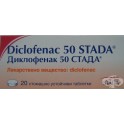
Pharmacological group: Analgesic and anti-inflammatory drug (NSAID / analgesic drug).
Active substance: dikpofenak. Pharmacologically active substance:
Each gastro-resistant tablet contains 50 mg diclofenac sodium
Excipients: Microcrystalline cellulose, lactose monohydrate, Macrogol 400, Macrogol 6000, magnesium stearate, corn starch, Methylhydroxypropylcellulose, O-acetyl-triethyl citrate, methacrylic acid copolymer (type C), povidone, colloidal anhydrous silica, talc, colorants E171, E172
Package
Original packaging with 20,50 or 100 gastro-resistant tablets. Pharmacological group: Analgesic and anti-inflammatory drug (NSAID / analgesic drug)
Indications
Symptomatic treatment of pain and inflammation in Acute arthritis (incl. Acute attacks of gout) Chronic Arthritis, in particular rheumatoid arthritis (chronic polyarthritis)
Ankilirasht spondylitis (Bechterew's disease) and other inflammatory rheumatic conditions of the spine - Inflammatory conditions arising from degenerative joint and spine diseases such as osteoarthritis (arthrosis) and spondylarthritis (spondylarthrosis)
- Soft tissue rheumatism
- Painful swelling or inflammation in trauma and postoperative disability.
A delay in the release of the active ingredient of Diclofenac 50 STADA, gastro-resistant tablets caused by resistant to the action of gastric juice pharmaceutical formulation, which may result in the start up delay of action of the medicinal product. Therefore Diclofenac 50 STADA should not be used for induction therapy, the rapid efficacy.
Contraindications
When you should not use Diclofenac 50 STADA?
Diclofenac 50 STADA should not be used in:
patients with known hypersensitivity to the active substance diclofenac or any of the other ingredients of the medicinal product;
patients with unexplained disorders of hematopoiesis and blood coagulation;
patients suffering from peptic or duodenal ulcer; gastrointestinal, cerebrovascular or other active hemorrhage;
in children and adolescents under 15 years.
When can you use Diclofenac 50 STADA only after consul-tation with your doctor?
Listed here are associated with certain conditions where Diclofenac STADA® 50 should be used with caution. Discuss them with your doctor and also in cases where these conditions are passed recently.
Diclofenac 50 STADA should be used with caution (ie the interval between doses or dose reduced) and under medical supervision:
- In patients with known hereditary disorders chemo-poetry (inductive porphyria)
- Patients with gastrointestinal complaints or indications of stomach or intestinal ulcers or enteritis (ulcerative kolit.bolest of Crohn) in the history of their disease;
- Patients with high blood pressure or heart failure;
- Patients with pre-existing renal impairment;
- Patients with severe hepatic impairment;
- In patients with systemic lupus erythematosus (SLE) or mixed forms of connective tissue disease (MSTD).
- In patients who have recently undergone complex surgery
What you should consider if you are pregnant?
Women who became pregnant during the prolonged use of Diclofenac 50 STADA should contact your doctor. In the first six months of pregnancy Diclofenac 50 STADA can be used only after consulting a doctor. In the last three months of pregnancy, Diclofenac 50 STADA should not be applied because of the increased risk of complications for mother and child during birth.
What you should consider if you are breastfeeding?
The active substance diclofenac and its metabolites pass into breast milk in small quantities. As they are not currently known harmful effects on the nursing infant, brief use does not require discontinuation of breastfeeding karmeneto.Obache that taking high doses of a long period of time should take into account a possible premature stop breastfeeding.
What should be considered for use by children and the elderly?
Diclofenac 50 STADA should not be used in children and adolescents up to 15 years due to insufficient danni.Za elderly patients undergoing treatment with Diclofenac 50 STADA, requires special careful medical supervision.
Precautions for use and warnings:
What you need to know?
In patients suffering from hay fever, nasal polyps or chronic obstructive respiratory disease (in m. Including asthma) or chronic respiratory tract infections, and in patients with known hypersensitivity to other analgesics or anti-rheumatic drugs from the group of non-steroidal anti-inflammatory / analgesic drugs, Diclofenac 50 STADA should be used with caution and under constant medical supervision. In these patients, an increased risk of hypersensitivity reactions (allergic reactions) when using Diclofenac 50 STADA, such as asthma attacks (ie. Analgesic asthma), local swelling of the skin or mucous membranes (angioneurotic edema) or rash ( urticaria).
Also, specific measures are necessary in patients who develop allergic reactions to other substances, since the application of Diclofenac 50 STADA increases the risk of hypersensitivity reactions.
If you use at the same time anti-clotting drugs "or drugs that lower blood sugar should be monitored for the circle-vosasirvaneto or blood sugar levels.
Diclofenac may temporarily inhibit platelet aggregation. Therefore patients with coagulopathy should be carefully monitored. Concomitant use of Diclofenac 50 Stada with lithium (drugs for the treatment of mental disorders) or potassium sparing diuretics requires monitoring of serum lithium or serum potassium (see. Interactions.)
In patients continuously treated with Diclofenac 50 STADA, should be monitored liver enzymes, kidney function and blood count.
Tell your doctor or dentist if you use Diclofenac 50 STADA, to take this into account before any surgical procedure.
It should be borne in mind that in women of childbearing age Diclofenac 50 can reversibly inhibit the ability to become pregnant due to reduced mobility of the egg in the mechanism of inhibition of prostaglandin synthesis.
What you should consider when driving, operating machinery or working on unstable platforms?
Because Diclofenac 50 STADA can have side effects on the central nervous system, causing eg fatigue or dizziness, your ability to drive and / or operate machinery may da.bade impaired. Consequently, you will not be able to react quickly and accurately enough to unexpected or sudden accidents. Therefore, you should not drive a car and whatever was motor vehicle under these circumstances. Do not operate electrical appliances or machines! Never operate on unstable platforms! In particular, when used the alcohol at the same time.
What else should you consider?
Prolonged use of high doses of pain medication, in razrez1 with their administration can lead to a headache which is not to be treated by increasing their dosage. Regular use of painkillers especially in adopting a combination of painkillers can lead to permanent kidney damage with the risk of renal failure (analgesic drug-induced nephropathy).
Drug Interactions
Which drugs interfere with the operation of Diclofenac 50 STADA and what you should consider when using other drugs' at the same time?
Please note that these warnings apply to recently accepted medikamenti.Ednovremennata use of Diclofenac 50 Stada® and digoxin, phenyl-in (anticonvulsant) or lithium (a medicine to treat psychiatric disorders) may increase the plasma concentration of these drugs.
Diclofenac 50 Stada can reduce the effect of diuretics and antihypertensive medicinal products.
Diclofenac Stada 50 can reduce the effects of ACE inhibitors (drugs for the treatment of cardiac failure and high blood pressure). Concomitant use can also increase the risk of developing renal failure.
Concomitant use of Diclofenac 50 Stada with potassium-sparing diuretics may cause an increase in plasma levels of potassium in the blood.
Concomitant use of Diclofenac 50 Stada and other NSAIDs or glucocorticoids increases the risk of adverse effects on the gastrointestinal tract (see. Undesirable effects).
Taking Diclofenac 50 Stada 24 hours before or after methotrexate may cause an increase in the concentration of methotrexate and thus to enhance the toxic effect of this medicine. Drugs containing probenecid or sulfinpyrazone (medicines used to treat gout) can delay the elimination of diclofenac. This can cause accumulation of diclofenac in the body, increased side effects.
Previous clinical trials have shown no interaction between .diklofenak and anticoagulants. However, in patients concomitantly treated with anticoagulants and diclofenac blood clotting should be monitored laboratory.
Non-steroidal antirheumatics (including diclofenac-natrium) may enhance the toxicity of cyclosporine on the kidney. Reports of the influence of diclofenac on blood sugar levels, requiring adjustment of the dosage of antidiabetic drugs. Therefore, to avoid potential problems with concomitant use of such drugs blood sugar levels should be monitored.
What foods, drinks and other substances you should avoid?
Avoid using - alcohol while taking Diclofenac 50 STADA.
Dosage, method and duration of administration:
The instructions given below apply if the doctor has prescribed dosage adjustment.
Please, stick to them and / or to the doctor's instructions for safe and effective treatment with Diclofenac 50 STADA
How many tablets Diclofenac 50 STADA and how often should you take?
Depending on the severity of the disease, the recommended daily dose
for adults and adolescents 15 years of age range from 50 to 150 mg of diclofenac - sodium daily, divided 1-3 priema.Otnosno dosing in children with rheumatic diseases is still not enough available observations.
Age
Adolescents (15 years) and adults
Single dose
1 gastro-resistant tablets (corresponding to 50 mg diclofenac sodium)
Daily Dose
1-3 gastro-resistant tablets (equivalent to 50-150 mg diclofenac sodium)
How and when should you take Diclofenac 50 STADA?
Gastro-resistant tablets should be swallowed whole with sufficient water and not gladno.Ako have a sensitive stomach is recommended to take Diclofenac 50 STADA during feeding.
How much time should be taken Diclofenac 50 STADA?
The duration of treatment should be determined by your lekar.Pri rheumatic diseases may need prolonged treatment with Diclofenac 50 STADA.
Overdose and other errors in the application:
Please take Diclofenac 50 STADA as directed by your doctor or dosage instructions given in this leaflet. If you sense that there are no pain relief, please do not increase the dose yourself, but ask your doctor.
What to do if you take more than the prescribed dose of Diclofenac 50 STADA?
If you forget to take once Diclofenac 50 STADA, please, do not take the next time more than usual prescribed dose.
What should be done in a possible overdose (knowingly or unknowingly) to Diclofenac 50 STADA?
Symptoms of overdose may include disorders of the central nervous system, e. headache, dizziness, drowsiness and loss of consciousness, but also in children and myoclonic seizures. Other symptoms may include abdominal pain, nausea and vomiting. Patients may also obtain, bleeding in the gastrointestinal tract and impairment of kidney and liver functions. There is no specific antidote. Of suspected overdose of Diclofenac 50 STADA, immediately contact your doctor who will decide what special measures must be taken depending on the severity of poisoning.
Undesirable effects
What side effects you may experience while using Diclofenac 50 STADA and what measures should be taken in case of their appearance?
The following adverse reactions are generally dose-dependent and vary between patients. In particular, the risk of bleeding in the gastrointestinal tract (ulcers, mucosal defects, gastritis) is dependent on the dosage and duration of treatment.
Gastrointestinal tract
When a patient to often may occur gastrointestinal complaints "such as nausea, vomiting and diarrhea, and mild bleeding in extremely rare cases can cause anemia. There were reports of indigestion, bloating, abdominal pain, loss of appetite and / or gastric or duodenal ulcers (with bleeding and perforation, in some cases). There have been rare reports of vomiting blood (haematemesis), blood in stool (melena) or bloody diariya.Ako feel moderately intense pain in the upper abdomen and / or get black stools, stop taking Diclofenac 50 STADA and contact your doctor nezabavno.Imalo is isolated reports of inflammation of the mouth and tongue, damage to the esophagus, constipation, pain in the lower part of the abdomen (eg. nonspecific hemorrhagic colitis, aggravation of inflammatory diseases of the bowel, i.e., Crohn's disease or ulcerative colitis). Isolated cases of narrowing of the intestine were observed.
Central -nervna system and sensory organs
Sometimes it can be observed adverse effects on the central nervous system such as headache, agitation, irritability, fatigue, drowsiness and dizziness.
There have been isolated reports of violations of perceptions, impaired sense of taste, visual disturbances (blurred or double vision), tinnitus (tinnitus) and reversible hearing loss, impaired memory, disorientation, seizures, feeling of anxiety, nightmares, tremor, depression and other psychotic reactions. In some cases, diclofenac was associated with signs of aseptic meningitis, including stiff neck, headache, nausea, vomiting, fever or blurred consciousness.
Warning:
If any of these symptoms appear or exacerbate stop taking Diclofenac 50 STADA and contact a doctor immediately!
Skin
Sometimes reported hypersensitivity reactions expressing. as rash sarbezh.a rarely urticaria or hair loss. There are isolated reports of rash with pustules (erythema, eczema), photosensitivity, skin petechial hemorrhages and severe forms of skin reactions (syndrome of Stevens-Jonson, toxic epidermal necrolysis).
Kidneys
There are isolated reports of damage to the renal Te-kan (interstitial nephritis, renal papillary necrosis) which can present with acute renal failure, protenu second and / or hematuria. In some cases it may appear nephrotic syndrome (edema and severe proteinuria). Decreased urine output, swelling and malaise can be an expression of kidney damage even to kidney failure. If any of these symptoms appear or exacerbate stop taking Diclofenac 50 STADA and contact a doctor immediately!
Liver
Sometimes reported increases in liver enzymes kravta.Ryadko some patients receiving liver damage (hepatitis with or without jaundice flowing severe in rare cases, even without prior symptoms). Therefore, you should regularly monitor liver function.
Pancreas
Rare cases of pancreatitis.
Blood
Rarely reported violations in hematopoiesis (anemia, leucopenia-ing, agranulocytosis, thrombocytopenia). Early symptoms may include fever, sore throat, superficial sores in the mouth, Gris-popodobni symptoms, fatigue, bleeding from the nose and skin bleeding. Patients with such features should stop taking Diclofenac 50 STADA immediately and consult a doctor without delay. Self-medication with analgesic or antipyretic drugs generally not recommended. Prolonged treatment requires regular monitoring of blood counts. Individual patients received hemolytic anemia
Cardiovascular system
There are isolated reports of palpitations, chest pain and high blood pressure. There are isolated reports of weakness of the heart muscle (heart failure).
Systemic reactions and other organ systems
Can be severe hypersensitivity reactions, which are expressed with a swollen face, swollen tongue, glottis edema that causes narrowing of the airways, shortness of breath to asthma attacks, tachycardia and blood pressure to life-threatening shock. If you experience any of these symptoms (which can happen even when taking the drug for the first time), the patient should seek immediate medical attention. Rarely edema (peripheral), primarily in patients with high blood pressure or kidney failure.
There are isolated reports of allergic inflammation of blood vessels (vasculitis) and lung (pneumonitis).
There are isolated reports of worsening of infectious inflammation. (Eg. The development of necrotizing fasciitis) in temporal relationship with the use of certain non-steroidal anti-inflammatory drugs (ie. Non-steroidal anti-inflammatory, to which the group belongs, and Diclofenac 50 Stada-). If you develop or worsen the signs or symptoms of infection (eg. Redness, swelling, hyperthermia, pain, fever) during treatment with Diclofenac 50 Stada® consult a physician immediately.
Be sure to follow the instructions given above, specific side effects! If you notice side effects not listed in this leaflet, please make sure your doctor or pharmacist.
Pharmacological group: Analgesic and anti-inflammatory drug (NSAID / analgesic drug).