
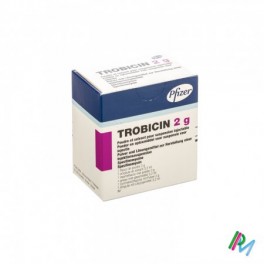
TROBICIN is indicated for the treatment of acute gonorrhea urethritis and proctitis in men and acute gonorrhea cervicitis and proctitis in women, due to susceptible strains of N. gonorrhea. Sexual partners of individuals diagnosed with gonorrhea should also be treated.
CLINICAL DATA
4.1. indications
TROBICIN is indicated for the treatment of acute gonorrhea urethritis and proctitis in men and acute gonorrhea cervicitis and proctitis in women, due to susceptible strains of N. gonorrhea. Sexual partners of individuals diagnosed with gonorrhea should also be treated.
TROBICIN is shown as an alternative treatment of shankaroid (caused by H. ducreyi).
4.2 Dosage and method of administration
In women or men, the recommended dose of spectinomycin HC1 of 2.0 g in an intramuscular injection. In difficult to treat cases in regions which are known to occur antibiotic resistance were applied to 4.0 g spectinomycin. Clinical efficacy of TROBICIN should be monitored to establish data for development of resistance of N. gonorrhoea.
dosage
Intramuscular injections should be made deep in the upper outer quadrant of the gluteal muscle.
adults
Inject a single dose of 2.0 g (5 ml) IM If necessary dose of 4 g (10 ml), 10-ml injection may be divided between two injection sites gluteal.
Preparation of drug for intramuscular injection
2 g TROBICIN: Dissolve the accompanying solvent of 3.2 ml. Shake bottle vigorously immediately after addition of the solvent and prior to withdrawal of the dose. The use of disposable syringes and needles for single use, in order to avoid contamination with a penicillin moiety, especially in the treatment of patients known to be hypersensitive to penicillin. It is recommended that 20 gauge needle gauge,
4.3 Contraindications
TROBICIN is contraindicated in patients with known hypersensitivity to it.
4.4 Special precautions and special precautions for use
TROBICIN is not indicated for the treatment of syphilis. Antibiotics used in high doses for short periods of time for the treatment of gonorrhea may mask or delay the early symptoms of syphilis. Therefore all patients be diagnosed gonorrhea, should be performed serological test for syphilis. Patients treated with TROBICIN, must be made control serological test for syphilis after three months.
Use in children
Although the safety and effectiveness of breastfeeding and childhood are not firmly established, there are reports that TROBICIN was effective in children in prepubertal age with uncomplicated gonococcal infection in a dose 40 mg / kg intramuscularly administered once.
TROBICIN not effective in the treatment of early syphilis or accompanying infections with C. trachomatis
TROBICIN should not be used in infants and children less than 3 years, as the solvent comprises benzyl alcohol. There are reports of a link between alcohol and petrol fatal "gaspmg syndrome" (a respiratory disorder characterized by prolonged panting) in premature infants.
4.5 Interactions
No data available.
4.6 Pregnancy and lactation
Use in pregnancy: Following oral or subcutaneous administration in rats at doses of 300 mg / kg / day spectinomycin not been found teratogenic or embryocidal. In rats was conducted teratology study at doses up to 2500 mg / kg, administered subcutaneously. There were no evidence of fetotoxicity or teratogenicity. There were no teratogenic effects when spectinomycin was administered intraperitoneally to mice or rats at dosages of 400, respectively, or 1600 mg / kg / day. Spectinomycin was administered intramuscularly or subcutaneously to pregnant rabbits at doses up to 300 mg / kg / day. Embryonic and fetal development were not affected by treatment. Since no controlled studies in pregnant women spectinomycin and as reggroduktivnite animal studies are not always predictive of human response, spectinomycin should be used during pregnancy only if clearly needed.
Use in nursing mothers is not known whether spectinomycin is excreted in human milk. Spectinomycin is excreted, however, in the milk of cows and sheep. (Note: Spectinomycin is poorly absorbed from the gastrointestinal tract).
4.7 Effects on ability to drive and use machines
It is unlikely to affect the ability to drive and use machines. Some patients have been reported only for dizziness and fever.
4.8 Undesirable effects
In clinical studies using single-dose were observed following reactions: soreness at the injection site, urticaria, dizziness, nausea, chills, fever and decrease in urine output (without changes in renal function, indicating renal toxicity).
The following effects have been observed in studies of tolerance of multiple doses in healthy volunteers: decreases in hemoglobin, hematocrit and creatinine clearance; increased alkaline phosphatase, bilirubin and SGPT.
In rare cases of anaphylaxis or anaphylactoid reactions.
4.9 Overdose
Not reported symptoms following overdose and toxicity.
Hemodialysis may reduce serum concentrations of spectinomycin medium-about 50% (in four patients surveyed in the study, serum concentrations decreased by 34.5 - 72.8% after dialysis).
5. PHARMACOLOGICAL
5.1 Pharmacodynamic properties
Spectinomycin is aminoniklitolov antibiotic that is produced by soil micro-organism Streptomyces spectabilis.
Spectinomycin inhibits bacterial protein synthesis by acting on ribosomal subunit H OS.
In vitro studies indicate that spectinomycin is active against most strains of Neisseria gonorrhoea (MIC: from 7.5 to 20 micrograms / ml).
It is possible, however, the occurrence of endemic resistance. Treponema pallidum and Chlamydia insensitive. In vitro studies have shown that N. gonorrhoea no cross-resistance between spectinomycin and penicillin.
5.2. Pharmacokinetic Properties
absorption
Spectinomycince rapidly and completely absorbed after a single IM dose of 2 to 4 g. distribution
Injections of 2 to 4 g spectinomycin results in a peak plasma concentration of about 100 mcg / ml or 160 micrograms / ml after one hour. After 8 hours the plasma concentration is between 15 and 30 mcg / ml. Binding of spectinomycin to plasma proteins is negligible.
biotransformation
Since studies have found that almost all the administered drug dose is eliminated intact, we assume that the drug does not undergo transformation.
It is mainly eliminated in the urine 24 to 48 hours after injection 70% to 90% of the administered dose was recovered in urine. In humans, the half-life is about 2 hours. Since no significant binding to plasma proteins spectinomycin antibiotic could theoretically be eliminated by hemodialysis.
5.3 Preclinical safety data
excretion
Tests for acute and chronic toxicity demonstrate that spectinomycin has little toxicity.
Acute toxicity:
LD5o mice (oral): 4.4 - 5.7 g / kg. Rats (oral): 7,5 g / kg
_
Subchronic and chronic toxicity:
In dogs, doses of 30, 100 and 300 mg / kg / day for more than 5 days did not result in any toxic symptoms. Body weight remained stable and did not appear changes in biochemical parameters. In one month dog study applied animal 300 or 1000 mg / kg daily. Were observed only salivation and local irritation at the injection site. Rats were administered subcutaneously 300 or 1000 mg / kg spectinomycin, dogs 300 and 800 mg / kg daily for three months. In this case, the substance also proves to be slightly toxic.
Reproduction / teratogenicity:
In teratogenic and reproductive studies no signs of teratogenic properties.
6. PHARMACEUTICAL PARTICULARS
6.1 List of excipients
Benzyl alcohol Water for injection
6.2 Incompatibilities
None
6.3 Shelf life
5 years
6.4 Special precautions for storage
Store undiluted product at room temperature of 25 ° C. Store reconstituted suspension at room temperature and use within 24 hours.
TROBICIN is indicated for the treatment of acute gonorrhea urethritis and proctitis in men and acute gonorrhea cervicitis and proctitis in women, due to susceptible strains of N. gonorrhea. Sexual partners of individuals diagnosed with gonorrhea should also be treated.